


In this guide
Do your hips feel tight, or does your lower back ache after a day at a desk? Perhaps your training isn't paying off as you'd hoped, and you have started to wonder why your glutes won't switch on properly. More often than not, these problems trace back to poor hip mobility and inactive glutes, something many of us share in today's largely sedentary lives.
The upside is that unlocking your hips and activating your glutes can bring better posture, stronger athletic performance and a lower risk of injury. Below, we look at why the two belong together and walk through simple ways to get results that last.
Hip mobility and glute activation: why both matter
What your hips do
Your hips are a key link in the body's kinetic chain, working like a powerful hinge for everything from walking to jumping. When they are tight or stiff, that basic movement pattern is thrown off. Over time, poor hip mobility can force other areas, such as the lower back or knees, to compensate, which leads to pain and stiffness.
Glute activation is about more than looks
The glutes (gluteus maximus, medius and minimus) are the engine room of the body. They help stabilise the pelvis, support an upright posture and produce explosive power in athletic movement. When they are inactive or underperforming, the result can be imbalances, lost strength and a greater risk of injury.
Signs your hips need unlocking and your glutes need waking up
- Lower back pain that won't go away: tight hips put unnecessary strain on the lower back.
- Restricted range of motion: trouble squatting, lunging or bending forwards can point to stiff hips.
- Flat or underdeveloped glutes: poor activation cuts gluteal strength and definition.
- Uneven gait or movement: a visible limp or asymmetry may come from poor hip mobility and inactive glutes.
What you gain from unlocking your hips and activating your glutes
- Better posture: relaxed hip flexors and engaged glutes help keep the spine aligned.
- Stronger athletic performance: powerful glutes drive running, jumping and lifting.
- Lower injury risk: balanced hips and active glutes reduce stress on the surrounding joints.
- More mobility: unlocking your hips increases your range of motion and flexibility.
How to unlock tight hips
1. Dynamic stretches
Add stretches that work the hip flexors, for example:
- Hip flexor stretch: kneel on one knee and lean forwards while keeping your chest tall.
- 90/90 stretch: sit with one leg in front and one behind, both bent to 90 degrees, then ease slowly into the front leg.


2. Foam rolling
Use a foam roller to ease tension in your hip flexors, quads and IT band, spending 1 to 2 minutes on each area before you train.
3. Controlled mobility drills
Try drills such as:
- Hip circles: standing, or on all fours, draw circles with one leg.
- World's greatest stretch: a whole-body stretch for the hips and the thoracic spine.
How to switch on your glutes
1. Glute bridges
Lie on your back, knees bent and feet flat. Push through your heels to raise your hips, squeezing your glutes at the top.
2. Clamshells
Lie on your side with your knees bent. Keeping your feet together, lift the top knee to work the gluteus medius.
3. Bird dogs
Start on all fours. Reach one arm and the opposite leg out, holding your balance while you engage your glutes.
4. Resistance band exercises
Add a resistance band for moves such as:
- Lateral band walks
- Monster walks
These raise the intensity and help target the glutes on their own.
If your hips keep tightening up again however much you stretch and activate, or your lower back or SI joint flares up alongside them, the question worth asking is what keeps rebuilding the pattern. In SI Joint Neuro Reset, Annette Verpillot shows you how to measure your own pattern at home, change one input your brain is reading, then retest, so you can see for yourself what makes a difference to your body.
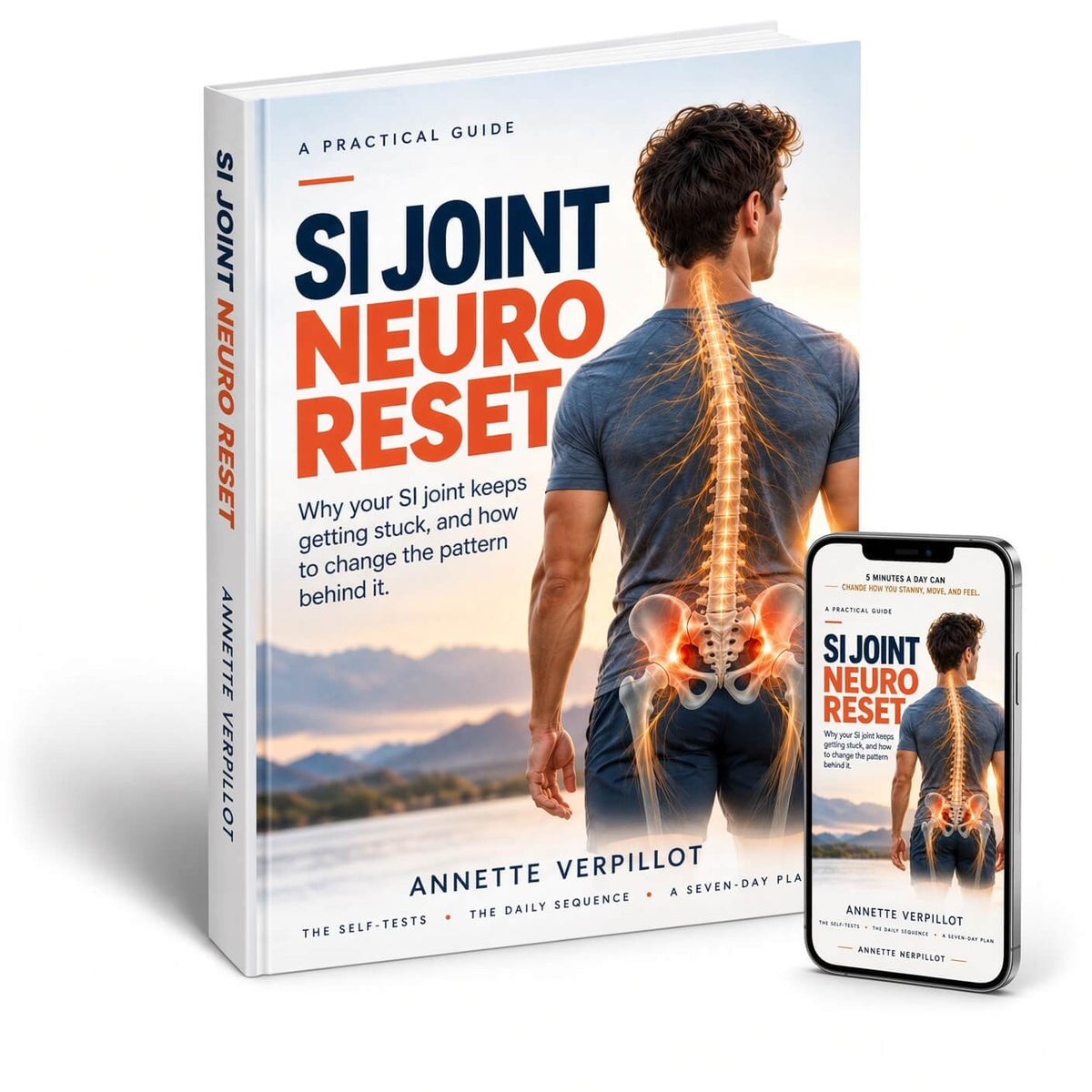
SI Joint Neuro Reset
Why Your SI Joint Keeps Getting Stuck, and How to Change the Pattern Behind It
- ✓ Find your pattern: foot-led, eye-led, balance-led or mixed
- ✓ A 28-day reset plan with a printable tracker
- ✓ A one-page plan for the day it jams again
Putting mobility and activation together
The approach that works best blends hip mobility work with glute activation drills. A sample routine:
- Foam rolling (2 minutes)
- Dynamic stretches (5 minutes)
- Activation drills (5 to 10 minutes)
- Functional movements such as squats or lunges
Combining these elements builds a balanced, efficient system that supports strength and flexibility alike.

Three-way leg swings
Stand on one foot and engage the glute of your standing leg to keep your balance. Root that foot firmly into the floor, brace your core and stay tall.
Forwards and backwards swings
Swing the free leg forwards and backwards, keeping both legs straight without locking the knees. Let the movement come from the hip joint rather than from bending the knee. Bigger swings make the standing leg work harder to keep you stable.
If balancing is tricky, begin with smaller swings and touch the swinging foot down to reset. Holding on to a wall takes balance out of the equation, though it also reduces the core and stability benefits.
Side swings
Once the forwards and backwards swings are done, move on to side swings. Swing the free leg out to the side, then across the front of your standing leg. You may feel your glute switch on as you lift and swing. Bigger swings boost hip mobility and ask more of the standing leg for balance.
Rotational swings
Finally, bend the knee of the swinging leg to 90 degrees for rotational swings. Bring the knee across in front of you, open it out to the side, then return to the start. Keep the knee bent the whole time and drive the movement from the hip. This works the glute of the standing leg and improves hip mobility.
Repeat all three variations on the other side.
Top tips:
- Prioritise control and activation over speed.
- If balance is hard, start with easier positions or smaller swings.
- You should feel your foot, calf, shin, glutes and core all working together.
Why bridging matters
Adding bridges to your routine is a straightforward, effective way to improve hip extension and switch on your glutes. Whether you pick a camel bridge, a tabletop bridge or a basic glute bridge, this move deserves a place in your daily practice.
What bridging does for you:
- Improves hip extension: bridges stretch and strengthen the hip flexors, helping to counter the tightness that long spells of sitting cause.
- Switches on the glutes: done with good form, bodyweight bridges allow a stronger glute contraction, so these muscles engage and work as they should.
- Supports mobility and pain relief: strengthening muscles through a better range of motion can ease pain in the hips, lower back and even the knees.
Making hip flexor mobility last
Stretching on its own will not keep your hip flexors unlocked. Without activation or strength work afterwards, the muscles often tighten again as soon as you sit back down. Focus instead on strengthening the muscles through the range you have just gained. That is what makes mobility gains last, and it helps prevent pain and stiffness.
Main points:
- Make a basic bodyweight glute bridge part of your routine, whatever your fitness level. Going back to foundational moves strengthens the mind-body connection and makes sure the right muscles engage.
- Bodyweight moves such as bridges often produce a stronger muscle contraction than more complex or loaded exercises.
Bringing activation, mobility and strength work together is how you unlock your hips, switch on your glutes and move better overall.

Fix the foundation, free the hips
Dealing with discomfort or poor alignment? The answer begins at your feet. Faulty foot mechanics can create imbalances that affect your posture, your gait and even your hip flexors. SI Joint Neuro Reset shows you how to find out whether your own pattern is foot-led, eye-led, balance-led or mixed, so you know which input to work on.
When you address foot mechanics, you can:
- Take strain off tight hip flexors and other key joints.
- Improve your posture and overall symmetry.
- Move with more confidence and ease.
To find out what keeps drawing your hips back into the same pattern, begin with SI Joint Neuro Reset.
SI Joint Neuro Reset
Why Your SI Joint Keeps Getting Stuck, and How to Change the Pattern Behind It
- ✓ Find your pattern: foot-led, eye-led, balance-led or mixed
- ✓ A 28-day reset plan with a printable tracker
- ✓ A one-page plan for the day it jams again
Your questions answered
How can you unlock tight hips?
Pair dynamic stretches, such as the hip flexor stretch and the 90/90 stretch, with foam rolling and controlled mobility drills like hip circles and the world's greatest stretch. Then strengthen your glutes through the range you have gained, so your hips stay free when you sit back down.
How do you unlock and switch on your glutes?
Begin with simple activation work: glute bridges, clamshells, bird dogs and resistance band walks. A basic bodyweight glute bridge suits every fitness level, as it often gives a stronger glute contraction than more complex or weighted exercises.
How can I unlock my SI joint myself?
Gentle movements such as the pubic symphysis release can encourage your SI joint to relax. Practising them consistently is what makes the difference.
Can the SI joint be reset without medical treatment?
Yes, SI joint discomfort often improves with exercise, better foot alignment and core strengthening. Posturepro's brain-based approach can also help by tackling alignment at its root.
Why does my SI joint keep locking?
Recurring SI joint pain usually comes from postural imbalances or weak core muscles. The body's natural alignment can be thrown off when the inputs from the feet, eyes or pelvis are out of balance.
How can I tell if my SI joint is out of alignment?
Lower back pain, hip discomfort or a sense that the pelvis is unstable can all point to SI joint misalignment. Looking at how your feet are positioned and how your hips line up can offer clues.
How do you tell SI joint pain apart from lower back pain?
It can be hard, because the two share many symptoms. SI joint pain, however, tends to sit in the buttocks and can spread down into the legs.
Is physiotherapy alone enough to treat SI joint dysfunction?
Physiotherapy can be very effective for managing the symptoms of SI joint dysfunction. Because it does not tackle the root cause, though, other approaches may also be needed.
Is surgery the only answer for chronic SI joint pain?
Surgery is usually a last resort for chronic SI joint pain, considered only once non-surgical treatments have been tried. It is important to explore conservative options first, such as posture correction, to deal with the main cause of the imbalance.
Can I keep exercising with SI joint problems?
Movement is said to stimulate the brain, but exercising with postural imbalances can lead to injury. Posture is controlled subconsciously by the brain and cannot be improved simply by trying harder. If your posture is out of line before you exercise, it stays that way while you exercise.
How long does recovery from SI joint surgery take?
It depends on the procedure and how quickly you heal, but full recovery can take several months. That is why prevention matters: dealing with postural problems early may help you avoid surgery altogether. Having your posture assessed can considerably reduce the risk of posture-related problems and the need for surgery.
Are there natural remedies for SI joint pain?
The main focus should be posture correction, to prevent joint misalignment and ensure the right pressure on the vertebral joints. Some people also find short-term relief from natural remedies such as turmeric, ginger or arnica cream.
References
- Day, B. L., Steiger, M. J., Thompson, P. D., & Marsden, C. D. (1993). Effect of vision and stance width on human body motion when standing: Implications for afferent control of lateral sway. The Journal of Physiology, 469(1), 479-499. PMC1143881
- Kavounoudias, A., Roll, R., & Roll, J. P. (2001). Foot sole and ankle muscle inputs contribute jointly to human erect posture regulation. The Journal of Physiology, 532(3), 869-878. PMC2278585
- Oyarzo, C. A., Villagrán, C. R., Silvestre, R. E., Carpintero, P., & Berral, F. J. (2014). Postural control and low back pain in elite athletes comparison of static balance in elite athletes with and without low back pain. PMID 23963269
- Shaikh, A. G., & Zee, D. S. (2017). Eye Movement Research in the Twenty-First Century-a Window to the Brain, Mind, and More. doi:10.1007/s12311-017-0910-5
- Wang, Z., & Newell, K. M. (2012). Asymmetry of foot position and weight distribution channels the inter-leg coordination dynamics of standing. doi:10.1007/s00221-012-3212-7
- Nejati, P., Safarcherati, A., & Karimi, F. (2019). Effectiveness of Exercise Therapy and Manipulation on Sacroiliac Joint Dysfunction: A Randomized Controlled Trial. Pain Physician, 22(1), 53-61. PubMed 30700068
- Tamer, S., Oz, M., & Ulger, O. (2014). Effects of sacroiliac joint mobilization on hamstring muscle flexibility and quadriceps muscle strength. Orthop J Sports Med, 2(3 Suppl). doi:10.1177/2325967114S00174