


In this guide
How sitting reshapes your posture (and the five-minute fix that helps)
At a glance: Posture problems affect a large share of the population. The typical office worker's head sits 5 to 7.5 cm in front of where it should be, roughly doubling the load on the neck muscles.
It is half past two. Your neck feels as if someone is driving a nail into it. Your shoulders have crept up towards your ears, and a nagging ache has settled into your lower back, one that began the moment you sat down this morning. You shift in your chair yet again, hunting for that elusive "comfortable position", which seems to last about thirty seconds before the discomfort returns.
Ring any bells?
If you are reading this slumped over your laptop right now (quick, sit up!), you are living what a large share of desk workers go through every day: the slow, steady erosion of your natural posture by the very chair you are paid to sit in.
What your company wellbeing scheme probably won't mention is that this is about more than comfort. Poor posture for office workers quietly drains your energy, focus, confidence and long-term health in ways that reach far beyond a sore back.
Worth knowing: Poor posture affects more than how comfortable you feel: it influences your breathing, your energy, how clearly you think and even how confident you come across at work.
Also worth reading: Ergonomic Office Setup: The Complete Guide to a Pain-Free Workday
What sitting really costs you, beyond a sore back

More than physical pain: it drains your vitality
When you think of sitting posture problems, back pain probably comes to mind first. That is only the tip of the iceberg. Poor posture quietly takes from you in ways you may not have noticed:
Energy: The mid-afternoon slump is not only down to lunch. When your spine is compressed and your chest caves in from slouching at a computer, your diaphragm cannot expand fully, so less oxygen reaches your brain and muscles. Little wonder you are worn out by Wednesday.
Confidence: Studies show that people who slouch report feeling less confident, less assertive and more anxious. If you cannot stand tall physically, it is hard to feel tall either, and that shows up in everything from your next presentation to your next pay review.
Focus: Forward head posture (the crane-like position where the head pokes out in front of the shoulders) creates tension in the cervical spine that directly affects brain function. The constant strain makes clear thinking genuinely harder.
Mood: Poor posture squashes the chest cavity, affecting your heart rate variability and your stress response. That is why you feel more irritable and overwhelmed after a day hunched over your desk.
What the research says: Each 2.5 cm your head moves forward of its ideal position roughly doubles the load on your neck muscles, from around 4.5 to 5.5 kg to somewhere between 9 and 14 kg.
The domino effect: how a desk job sets off a chain reaction

Here is the hard truth about desk posture correction: your body is built to move, not to hold one position for eight hours or more. Force it to sit still that long and things start to give way:
- Your hip flexors shorten and tighten from being bent at 90 degrees all day
- Your glutes "switch off" from lack of use (gluteal amnesia really does exist)
- Your upper back rounds as your chest muscles tighten and the upper back weakens
- Your head drifts forward as you lean in towards the screen
- Your shoulders roll in as the upper trapezius works overtime to make up for weak deep neck flexors
How fast it happens: The chain reaction starts within the first hour of sitting and builds day after day. It is not a slow process that takes years.
Posture myths that hold you back (and why "sit up straight" fails)
Myth 1: "Just remember to sit up straight"
If willpower were enough, you would not be reading this. The trouble with consciously correcting your posture is that your brain has better things to do than check your shoulders every second of the day.
In practice: What you need is systematic muscle retraining, not a stream of mental reminders.
Myth 2: "A pricey ergonomic chair will sort it out"
Ergonomic office furniture is a multi-billion industry, yet neck and shoulder pain from office work keeps rising. The reason is simple: ergonomic chairs deal with symptoms, not causes.
In practice: No chair can undo shortened hip flexors, weak glutes and a forward head posture that has been building for years.
Myth 3: "There's no time to exercise at work"
This is the biggest myth of the lot. Believing you need an hour at the gym to tackle sitting posture problems is exactly what keeps most people in pain.
In practice: The posture exercises for office workers that work best take only minutes and can be done at your desk.
A reality check on time: Research shows that short, targeted breaks of 3 to 7 minutes spread across the working day work better than longer sessions after work.
What is really behind poor desk posture (it is not what you think)
It is your movement patterns, not your chair
Everyone fixates on finding the "perfect chair", but that misses the point. The issue is less what you sit in and more how long you sit, and what that does to the way you move.
When you sit for long stretches:
- Your brain "forgets" how to switch on your postural muscles properly
- Your body moulds itself to the chair rather than to its natural alignment
- Your proprioception (your sense of where your body is) is dulled
- Your postural reflexes grow weaker
Forward head posture is everywhere
Forward head posture from sitting is not just a question of looks; it is a real biomechanical problem. Every 2.5 cm your head drifts forward of its ideal position over the shoulders roughly doubles the load on your neck muscles.
With the typical office worker's head 5 to 7.5 cm forward, the neck muscles are holding up 9 to 14 kg rather than the usual 4.5 to 5.5 kg. Small wonder the tension never lets up.
Hip flexors: a problem waiting to happen
Your hip flexors (the muscles linking your spine to your thighs) are made for walking, not sitting. Hours in a chair make them adapt by shortening and tightening, which tugs on the lower back and tips the pelvis forward into the "duck bottom" posture behind so much chronic back pain.
The breathing link nobody mentions
Few people realise that poor posture directly affects how you breathe. When the chest caves in and the shoulders round forward, the diaphragm cannot work properly, so you end up breathing shallowly into the chest instead of deeply into the belly.
Breathing shallowly all day keeps your nervous system in a state of low-level stress, which is why you can feel anxious and drained even on a "quiet" day at the office.
Read next: Office Stress: The Five-Minute Breathing Reset
Why nothing has worked so far (and it is not your fault)
The quick-fix trap
Perhaps you stretch your neck when it tightens, or roll your shoulders back when you remember. You may even have bought a standing desk converter or a lumbar cushion.
None of these is a bad idea, but they are sticking plasters on a bullet wound. They bring short-term relief without touching the muscle imbalances and movement patterns that caused the problem.
The "no time" problem
Most posture exercises for office workers online ask for 30 to 60 minutes a day. Between the commute, work, family and some kind of social life, who has an hour spare for corrective exercise?
That is why most people start out with good intentions and give up within a week or two. The answer has to fit the life you actually lead, not the one you wish you had.
Too much information, too little action
Search for "how to fix posture while working at a desk" and you will find millions of results full of conflicting advice. One site tells you to stretch your hip flexors, another to strengthen them. One expert swears by a standing desk; another warns it brings its own problems.
Faced with so much contradictory advice, doing nothing can feel safer than doing the wrong thing.
The real problem: Most solutions either take too long for busy professionals or give such mixed messages that people freeze instead of acting.
If long days at a desk leave your neck, shoulders and lower back stuck in the same slumped pattern, you need something that fits into the working day rather than another hour of exercise.
5 Minute Posture Fix
Improve Your Desk Posture in Just 5 Minutes a Day
Working at a Desk All Day? Stop Letting Your Posture Pay the Price.
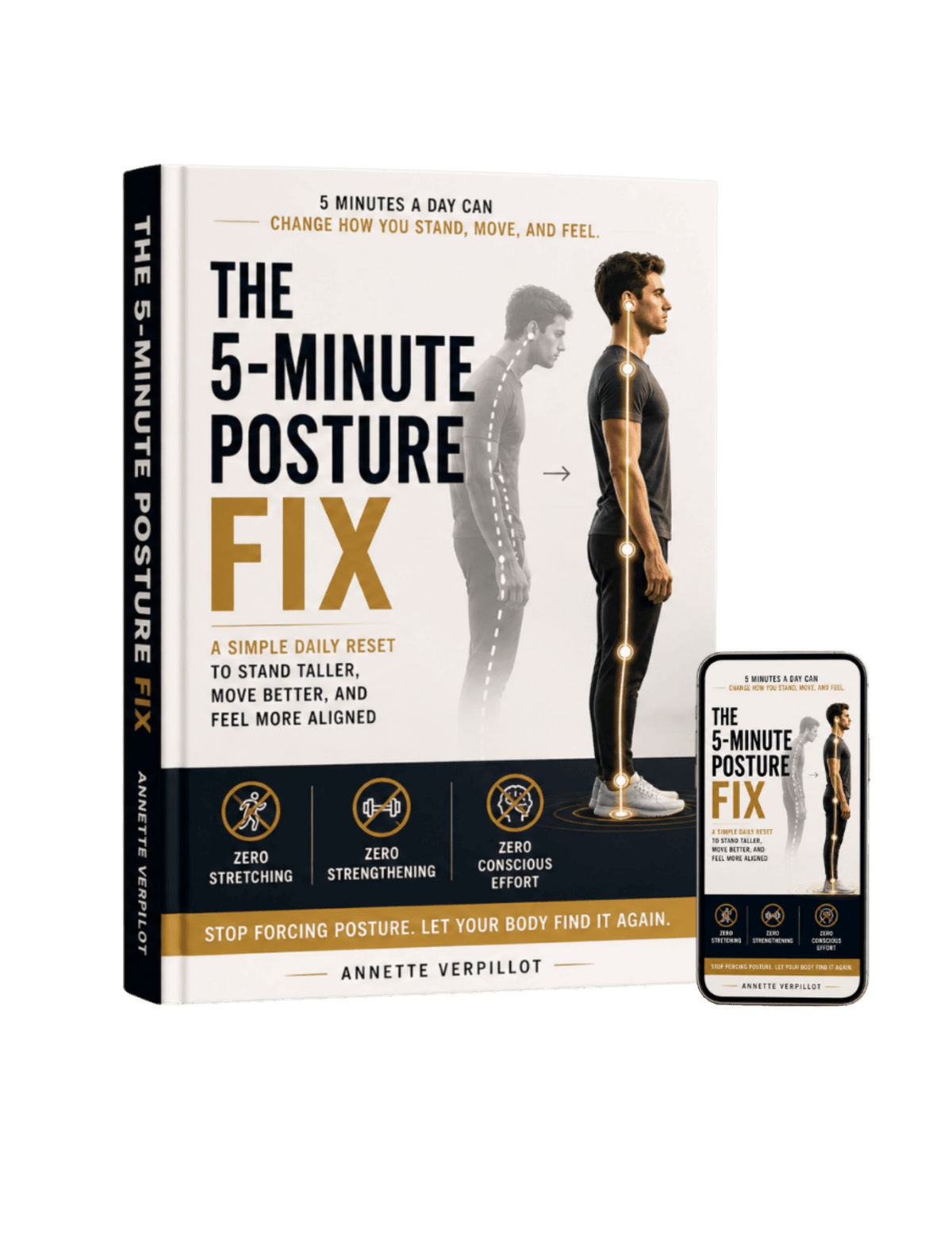
- ✓ Help reduce rounded shoulders and forward head posture caused by long hours sitting at a computer.
- ✓ Follow a simple, guided 5 minute routine designed for people who work from home or spend their days at a desk.
- ✓ Improve your posture without spending hours exercising, buying equipment, or constantly reminding yourself to sit up straight.
What the evidence points to for office workers

Small doses, big difference
Imagine if the most effective posture for office workers correction needed no gym membership, no expensive kit and not even a change out of your work clothes.
The breakthrough is not doing more; it is doing the right things, in the right order, for the right amount of time.
From the research: Studies in occupational health show that short, targeted breaks during the working day work better than longer exercise sessions after work.
What your body needs is frequent "posture breaks" to reset, not marathon correction sessions.
Why movement quality matters
Traditional approaches stretch what is tight and strengthen what is weak, but they miss a piece: movement quality. You can stretch your hip flexors and strengthen your glutes, yet if your brain has forgotten how to coordinate them, you will slip back into old habits within hours.
Lasting desk posture correction needs neurological retraining: teaching your nervous system new, healthier movement patterns until they become automatic.
Why compound movements win
Rather than isolated stretches that work one muscle at a time, the most effective approach uses compound movements that deal with several postural problems at once.
A single well-chosen exercise can, for example:
- Free up tight hip flexors
- Wake up sleepy glutes
- Improve mobility through the upper back
- Strengthen the deep neck flexors
- Reset the way you breathe
That is why a well-designed five-minute posture routine can achieve more than an hour of random stretching.
The efficiency rule: One properly designed compound movement that tackles several postural problems at once beats a string of isolated exercises.
The five-minute posture fix: a faster route to a pain-free working day

Why five minutes works
Research shows that around 3 to 7 minutes of targeted movement is enough to:
- Reset muscles that have shortened
- Switch on muscles that have gone quiet
- Restore good joint position
- Settle an overactive nervous system
Just as importantly, five minutes is sustainable. It is short enough that you will actually keep doing it, yet long enough to bring about real physical change.
Where to go from here: Understanding the problem is step one. The real change comes from a systematic, evidence-based approach that fits into a busy working week. Small, regular actions add up to a big difference in how you feel and perform at work.
If your sitting posture slumps the moment your attention drifts, the resting pattern your brain falls back on is what needs correcting.
5 Minute Posture Fix
Improve Your Desk Posture in Just 5 Minutes a Day
Working at a Desk All Day? Stop Letting Your Posture Pay the Price.
- ✓ Help reduce rounded shoulders and forward head posture caused by long hours sitting at a computer.
- ✓ Follow a simple, guided 5 minute routine designed for people who work from home or spend their days at a desk.
- ✓ Improve your posture without spending hours exercising, buying equipment, or constantly reminding yourself to sit up straight.
Your questions answered
Why do desk workers end up with rounded shoulders and a forward head?
Hours of sitting trigger a chain reaction. The upper back rounds as the chest muscles tighten and the upper back weakens, the head drifts forward as you lean towards the screen, and the shoulders roll in as the upper trapezius overworks to make up for weak deep neck flexors.
How long does forward head posture take to correct?
Many people feel less tension within the first week of regular practice, with significant postural change usually within 2 to 4 weeks. As forward head posture develops over years, the improvement holds when the underlying muscle imbalances and movement patterns are retrained rather than simply stretched.
How soon will posture exercises make a difference?
Many people notice more energy and less tension within the first week. Bigger postural changes usually follow within 2 to 4 weeks of regular practice.
Can I do posture exercises at my desk discreetly?
Yes. The most effective desk exercises are designed to fit quietly into your normal working day, even while you read emails or sit in meetings.
Can forward head posture be reversed?
Yes. With regular, targeted exercises that address the underlying muscle imbalances and movement patterns, forward head posture can be improved considerably and is often fully corrected.
Why won't an ergonomic chair fix my posture?
Ergonomic chairs deal with symptoms, not causes. They cannot undo shortened hip flexors, weak glutes or the neurological patterns behind poor posture. That takes active movement and muscle retraining.
How does poor posture affect your productivity?
Poor posture cuts the oxygen reaching your brain, creates distracting discomfort, adds to fatigue and can knock your confidence, all of which take a real toll on performance and productivity at work.
What does good sitting posture at a desk look like?
Good sitting posture at a desk means feet flat on the floor, knees at roughly 90 degrees, your lower back supported by the chair, relaxed shoulders, and the top of the screen at eye level so your head stays balanced over your shoulders rather than drifting forward.
How can I improve my sitting posture?
Sort out your set-up first, then your habits. Put your chair, screen and keyboard into neutral positions, then reset your position regularly through the day. If your posture keeps slumping as soon as your attention wanders, the resting pattern your brain falls back on is what needs correcting, not just the furniture.