


In this guide
Why your SI joint pain keeps coming back
You deal with your SI joint pain. A few days later, it has returned.
If it keeps locking up on the same side, the SI Joint Neuro Reset ebook shows you how to identify what keeps triggering it. There is more on this further down.
Perhaps you have tried stretching, strengthening work or even chiropractic adjustments. Hip flexor stretches. Glute bridges. Pelvic tilts. Each video promises relief, yet the pain keeps coming back.
Within a week, the familiar ache in your lower back has crept back in. Your pelvis feels unsteady, your hips feel tight, and whatever you try, your body seems to be working against you.
If that rings a bell, you are far from the only one.
Most people assume SI joint pain is purely structural, something the right stretch or adjustment should sort out. So they keep working on the same spot. In reality, if your SI joint flares up whatever you do, the root cause may be sitting somewhere else entirely.
What if the problem is not the joint at all, but the way your brain interprets the signals coming from your body?
This guide explains why three simple exercises can work where everything else has failed, and why genuine SI joint relief begins with the foundation rather than the symptoms.
If you are fed up with the constant loop of pain and short-lived relief, this may finally join up the dots.
Read more: why your feet are weak, and how that affects the pelvis above them (free e-book included with the Posturepro+ subscription).
SI joint anatomy: what is the SI joint, and what does it do?
Having named the frustration, the never-ending loop of pain and brief relief, it is time to look under the bonnet.
The sacroiliac (SI) joint is one of the body's most important stabilisers. It links your spine to your pelvis and takes an enormous load with every step.
SI joint function depends on a delicate balance between stability and mobility. The joint moves very little, just a few degrees of rotation and translation, yet that small range is essential for spreading weight evenly and absorbing shock.
Some of the strongest ligaments in the body hold the SI joint in place:
- Posterior sacroiliac ligaments: the joint's main source of stability, resisting forward movement of the sacrum.
- Interosseous ligaments: sitting deep inside the joint, they limit excess movement and keep the joint aligned.
- Sacrotuberous and sacrospinous ligaments: they anchor the sacrum to the pelvis and help govern how the pelvis is positioned.
- Iliolumbar ligaments: running from the spine to the pelvis, they shape SI joint mechanics through their influence on the position of the lumbar spine.

The trouble is that most treatment approaches end there.
What they overlook is that the SI joint never works on its own. It belongs to a longer chain that begins at your feet and continues up through the pelvis and spine. When the feedback from that chain reaches your brain in distorted form, the body can compensate in ways that put abnormal stress on the SI joint.
So if you have been concentrating on treating the SI joint in isolation while the stability of your foundation is off, the results are unlikely to last.
What really drives SI joint dysfunction?
It is tempting to blame an old injury or an awkward movement. Trauma can certainly set off SI joint problems, but it is often simply the last straw.
What is seldom discussed is how the brain adapts to small imbalances across the body and begins to reinforce faulty patterns as the "new normal".
This is how it unfolds:
Once your feet lose stability, the pelvis compensates. Once the pelvis tilts or rotates, the SI joint takes an uneven load. Your brain, constantly working to keep you balanced, strengthens whichever pattern keeps you upright, even when that pattern causes pain.
Gradually, the muscles that should stabilise your pelvis lose track of their role. Some become overactive and tight, while others switch off and weaken. That is where SI joint stiffness, inflammation and chronic pain start.
Fixing SI joint dysfunction, then, is not a matter of manipulating the joint or adding more hip stretches. It means retraining the systems that govern pelvic stability and rebuilding healthy movement patterns from the ground up.
How your feet shape your pelvis
Your feet are the body's first point of contact with the ground. When foot posture is poor, for example with flat feet, the pelvis above has to adjust and the SI joint ends up carrying the difference. That is why this guide keeps coming back to the foundation, and why foot-led is one of the four patterns SI Joint Neuro Reset teaches you to test for.
Research indicates that when the brain misinterprets the signals coming from the body, imbalances can follow that load areas such as the SI joint. If the joint is pushed out of alignment by postural problems, massage or bodywork on their own will not resolve the cause of the pain.
With the underlying cause in view, let's turn to the three exercises that begin to fix it from the foundation upwards.
You will not need forceful stretching or heavy resistance. Gentle, controlled movements can be surprisingly effective when they target the right systems.
Stuck again? Find out what keeps rebuilding the pattern
If your SI joint feels free after an adjustment, then locks up again a few days later, the question worth asking is not how to unlock it one more time. It is what keeps putting the pattern back. In SI Joint Neuro Reset, Annette Verpillot shows you how to measure your own pattern at home, change one input your brain is reading, then retest, so you can see for yourself what makes a difference to your body.
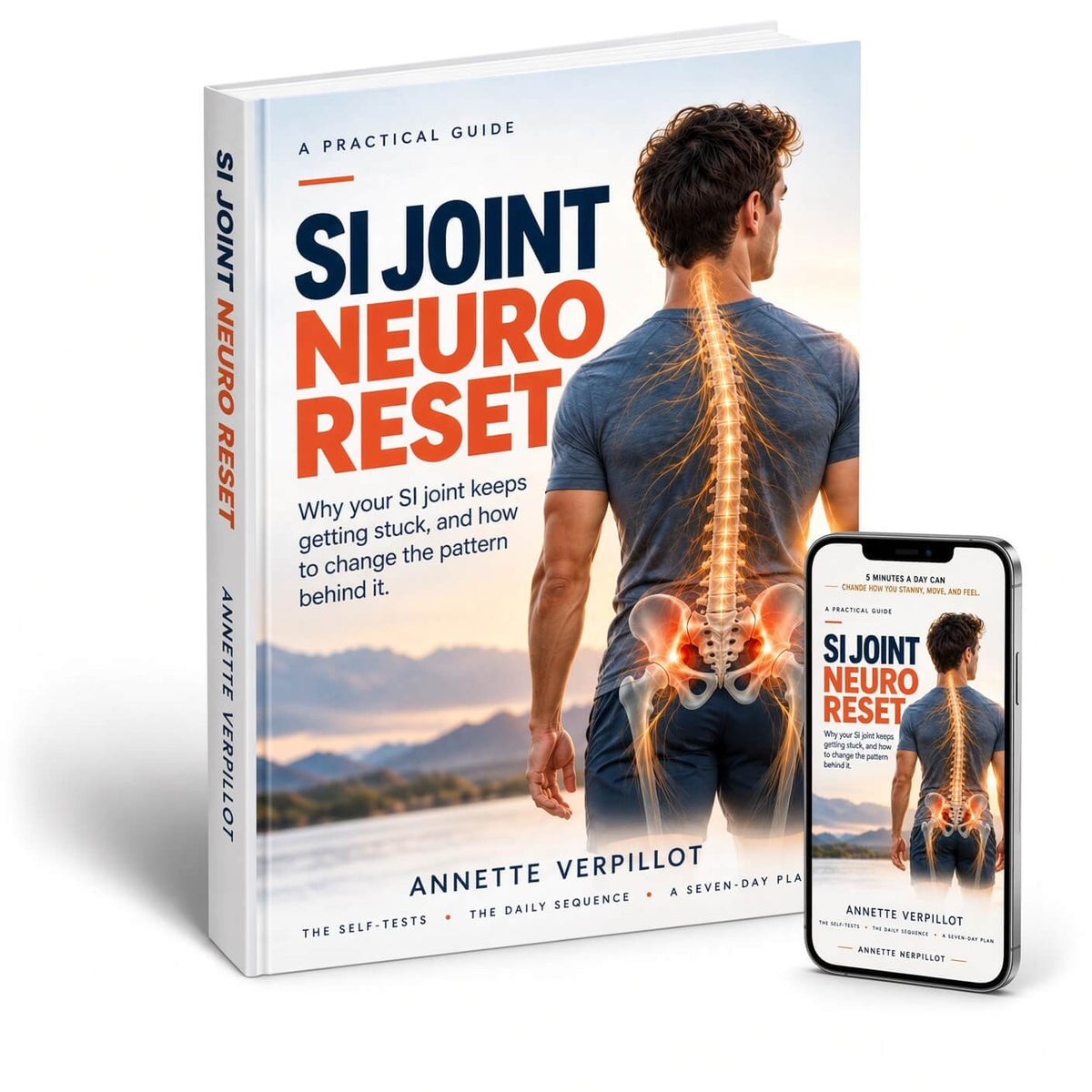
SI Joint Neuro Reset
Why Your SI Joint Keeps Getting Stuck, and How to Change the Pattern Behind It
- ✓ Find your pattern: foot-led, eye-led, balance-led or mixed
- ✓ A 28-day reset plan with a printable tracker
- ✓ A one-page plan for the day it jams again
Three gentle exercises for SI joint relief
Important: these exercises help retrain SI joint stability, but if your foot mechanics are not addressed first, the compensation patterns will keep coming back. That is why the foundation work later in this guide matters as much as the movements themselves.
1. Pubic symphysis exercise

How to do it:
- Lie on your back, knees bent and feet flat on the floor
- Put a small ball or a rolled-up pair of socks between your knees
- Squeeze the ball very gently for a count of five, then let go slowly
- Do 3 to 5 repetitions, using your pain level as your guide
- Aim for gentle activation, not maximum effort
Safety note:
The exercise should feel gentle and comfortable throughout. If you feel sharp pain or notable discomfort, ease off the pressure or stop.
2. Advanced quadriceps stretch

How to do it:
- Lie on your side, bottom leg slightly bent to keep you stable
- Take hold of your top foot, ankle or shin behind you
- Draw the foot gently towards your glute
- Hold for 30 to 60 seconds while breathing deeply
- Change sides and repeat
- Concentrate on letting go of tension in the front of the thigh
Safety note:
Do not yank on the leg. The stretch should feel comfortable enough to hold. If your foot is out of reach, loop a towel or strap around it to help.
3. Knee-to-chest stretch

How to do it:
- Lie on your back with both legs straight
- Slowly bring one knee towards your chest, holding it with both hands
- Hold for 30 to 60 seconds and feel the stretch through your hip and lower back
- Let go and repeat on the other leg
- To take it further, bring both knees to your chest at the same time
- Keep breathing deeply throughout
Safety note:
Go slowly and never force the stretch. Stop straight away if you feel sharp pain or notable discomfort in your lower back or around the SI joint.
Progression plan
Weeks 1 to 2: do the exercises every day, concentrating on gentle movement and good form.
Weeks 3 to 4: keep up the daily practice and keep track of changes in pain and mobility.
Month 2 onwards: stay consistent and add further strengthening exercises as your body tolerates them.
Fixing the foundation
Dealing with SI joint pain, pelvic instability or persistent lower back tension? The answer starts at your feet. Poor foot mechanics set up imbalances that travel up through the body, throwing off pelvic alignment and loading the SI joint abnormally.
The receptors in the soles of your feet are a key source of the information your brain uses to organise posture. When that input is off, the pattern above it follows, which is why SI Joint Neuro Reset has you test whether your own pattern is foot-led before you change anything.
When you correct your foundation, you can:
- Take strain off the SI joint and the muscles around it
- Improve your posture and overall symmetry
- Move with more confidence and stability
- Find more lasting relief from SI joint pain
When to expect results
Many people notice a change in stability and posture awareness as soon as they start doing these exercises regularly. The neurological benefits of better SI joint positioning begin to build within the first week.
Changes in muscle activation and joint alignment usually become noticeable after 2 to 4 weeks of steady practice. Bear in mind that you are retraining movement patterns that may have been faulty for years. That takes patience, but done properly, it leads to lasting change.
In summary
Resolving SI joint pain is not about piling on more treatments. It is about choosing the right exercises, the ones that deal with the root cause. These three movements work on the key systems behind pelvic stability and SI joint alignment, but lasting change still depends on sorting out your body's foundation.
Pair targeted exercises with work on that foundation and you have a joined-up approach that tackles both the symptoms and the underlying cause of SI joint dysfunction.
Start practising these exercises regularly, and think about how your body's foundation may be feeding into your SI joint problems. Your pelvis, and the rest of your body, will be grateful for this whole-body approach to recovery and prevention.
To discover what keeps locking up your own SI joint, begin with SI Joint Neuro Reset.
SI Joint Neuro Reset
Why Your SI Joint Keeps Getting Stuck, and How to Change the Pattern Behind It
- ✓ Find your pattern: foot-led, eye-led, balance-led or mixed
- ✓ A 28-day reset plan with a printable tracker
- ✓ A one-page plan for the day it jams again
Frequently asked questions about SI joint pain
Why does my SI joint keep going out or jamming?
Because the pattern behind it keeps being rebuilt by the feet and other inputs. The pelvis compensates, and the joint ends up carrying the load once more. The exercises and foundation work in this guide tackle that cycle; SI Joint Neuro Reset shows you how to test which input is driving yours.
What is SI joint syndrome, and what does it do to the body?
SI joint syndrome is the term used when the sacroiliac joint, which sits between the spine and the pelvis, becomes irritated or inflamed. It often stems from misalignment, such as a rotated pelvis, which puts uneven stress through the joint. Left unaddressed, this can bring pain, stiffness and reduced mobility. Stabilising the foundation of your posture, starting at the feet, helps correct these imbalances and takes unnecessary strain off the SI joint.
Which SI joint pain treatments are most effective?
Treatment for SI joint pain usually combines targeted exercises, gentle stretches and therapeutic work. The approaches that tend to work best are SI joint strengthening exercises, SI joint stretches for pain relief and postural correction that starts at the feet. Adding brain-based methods, such as improving body alignment and muscle activation, can bring longer-term relief instead of short-lived symptom management.
How long before you see results from SI joint exercises?
Many people feel a difference in stability and posture awareness within the first week of regular practice. Changes in muscle activation and joint alignment usually become noticeable after 2 to 4 weeks. Working on your foot mechanics alongside the exercises supports that process while your muscles strengthen and your movement patterns improve.
Can SI joint dysfunction be fixed permanently?
In many cases, yes. Sacroiliac joint dysfunction can often be resolved over the long term once the root causes, usually postural imbalances and faulty movement patterns, are addressed. What matters is correcting the issues that created the dysfunction in the first place, not simply treating the symptoms. Working on the foundation at the same time helps good alignment hold while you strengthen the supporting muscles and retrain how you move.
What tends to make SI joint pain worse?
Everyday triggers include sitting for long periods, going up stairs, running on uneven ground and sleeping on your side without enough support. Behind these, poor foot mechanics and postural imbalances are often what turns such activities into a problem. Tackling those foundation issues with targeted exercises and the right support can considerably reduce pain and help prevent future flare-ups.
Which exercises are best for SI joint pain?
The best exercises for SI joint pain are the three covered in this guide: the pubic symphysis exercise, the advanced quadriceps stretch and the knee-to-chest stretch. Practised gently and regularly, they retrain pelvic stability instead of chasing symptoms.
Which stretches help relieve sacroiliac joint pain?
This guide uses two: the advanced quadriceps stretch and the knee-to-chest stretch. To ease SI joint pain without irritating it further, keep the range of movement small, go slowly and let comfort be your guide.
How can you unlock a jammed SI joint by yourself?
To unlock or release a stuck SI joint by yourself, choose slow, low-load movement such as the pubic symphysis exercise instead of forceful cracking. Fixing SI joint pain at home also means dealing with the foot mechanics beneath the pelvis, not only working on the joint itself; otherwise the jam keeps coming back.
What are the main symptoms and causes of SI joint pain?
Typical SI joint pain symptoms are an ache on one side of the lower back or buttock, stiffness after sitting and pain on the stairs. The most common cause of SI joint pain is uneven load from below: poor foot mechanics tilt the pelvis and leave the joint absorbing stress it was never designed to carry.
Are sacroiliitis and SI joint dysfunction the same thing?
Not quite. Sacroiliitis means inflammation of the sacroiliac joint, whereas SI joint dysfunction describes how the joint moves and carries load. Sacroiliitis treatment and settling SI joint inflammation both benefit from the same foundation work, because gentle sacroiliitis exercises and corrected foot mechanics lower the load that drives the irritation.
References
- Day, B. L., Steiger, M. J., Thompson, P. D., & Marsden, C. D. (1993). Effect of vision and stance width on human body motion when standing: Implications for afferent control of lateral sway. The Journal of Physiology, 469(1), 479-499. PMC1143881
- Kavounoudias, A., Roll, R., & Roll, J. P. (2001). The Journal of Physiology, 532(3), 869-878. PMC2278585
- Cohen, S. P., Chen, Y., & Neufeld, N. J. (2013). Sacroiliac joint pain: a comprehensive review of epidemiology, diagnosis and treatment. Expert Review of Neurotherapeutics, 13(1), 99-116. PMID 23253394
- Vleeming, A., Schuenke, M. D., Masi, A. T., et al. (2012). The sacroiliac joint: an overview of its anatomy, function and potential clinical implications. Journal of Anatomy, 221(6), 537-567. PMID 22994881
- Laslett, M. (2008). Evidence-based diagnosis and treatment of the painful sacroiliac joint. Journal of Manual & Manipulative Therapy, 16(3), 142-152. PMC2582421