


Plenty of stretching, plenty of strengthening, and still your shoulders roll forwards. Here is the part that rarely gets explained, along with the test that shows where the problem really begins.
In a nutshell
Rounded shoulders (sometimes described as hunched, slumped or forward shoulders) tend to follow the head: once the head drifts forwards, the brain rounds the shoulders to keep you balanced. That is why chest stretches and rows only bring short-lived relief. Use the mirror check and the wall test below to see your pattern, then work in sequence: correct the feedback first, then release, strengthen and practise the new position.
In this article
How to Tell If Your Shoulders Are Rounded
Stand side-on to a mirror with your arms hanging loosely, and look at where your shoulders sit.
- Can you see the outline of your upper back behind the shoulder?
- Is your shoulder clearly in front of your ear?
If the answer is yes, you are looking at typical rounded-shoulder posture. That forward position is not random slouching. Your brain is actively holding it there because, to the brain, it feels "normal" and balanced.
Three common signs that rounded shoulders are part of your pattern:
- With your arms relaxed by your sides, your palms face backwards.
- Your chest still feels tight even though you stretch it regularly.
- Your upper back curls forwards the moment you stop thinking about posture.

Most people conclude that the chest is tight and simply needs more stretching. In many stubborn cases the reverse is true: the tight chest is a consequence of the posture rather than its cause. The rounded shoulder is compensating. The real issue is whatever draws the whole shoulder complex forwards to begin with.
Why Shoulder Exercises Keep Letting You Down
You have done everything you were told to do for rounded shoulders: chest stretches, rows, squeezing the shoulder blades together. Perhaps a physiotherapist gave you a detailed corrective programme. The shoulders come back for a while, then drift forwards into the same rounded position.
In these persistent cases, rounded shoulders are a positioning problem rather than simply a muscle problem. Your body is following a physics equation that your brain has already worked out.
When the sensory feedback your brain relies on to orient you against gravity changes, the head tends to move forwards. To stop you toppling, the shoulders round to compensate.
Put simply, the shoulders take their lead from the head. To stop them rounding, you need to know why the head sits forward in the first place, and answering that takes you one step further up the chain.
This is a pattern problem, not a local shoulder problem.
The brain controls where your shoulders sit, but it never places them on their own. It places them in relation to your head, and the head's position depends on feedback from three key sensory systems that tell the brain where you are in space and how gravity is acting on you.

Once the head drifts forwards within that system, the shoulders must round to counterbalance it. The brain runs this calculation constantly in the background. That is why you can hold your shoulders back for a few minutes, yet no number of "sit up straight" reminders will override the pattern for long if the feedback upstream has not changed.
What Is Really Going On
Your brain rounds your shoulders because your head sits forward, and your head sits forward because the sensory feedback reaching the brain is distorted. Your shoulders are doing precisely what they should: compensating for a position your brain has judged necessary.
That explains why two people can spend the same hours at a desk and only one ends up with rounded shoulders. The desk is not what differs. The feedback each brain receives is.
The Pattern Running in Your Brain
Each of these sensory systems keeps the brainstem continuously informed about where your body is in space. When that information is clear, the head settles naturally into a centred position and the shoulders follow. When it is distorted, the head drifts forwards and the shoulders round to keep you balanced.
This is the nervous system compensating, not a weakness in the muscles. The muscles are carrying out the pattern flawlessly; the pattern itself is what needs to change.
Here is the sequence:
Distorted feedback arrives at the brainstem, which moves the head forwards through the pathways that govern posture. The shoulders round to counterbalance the head, and the spine curves to stay upright. All of this happens without your conscious awareness.
Willpower cannot undo a pattern set at the level of the brainstem. You can override it for a while by deliberately "pulling your shoulders back", but as soon as your attention moves on, the brain reinstates the compensation it decided was needed.
That is why correcting your posture so often feels "wrong". To the brain it genuinely is wrong, because it is still reacting to feedback that has not changed.
Once the feedback is corrected, the brain recalculates. The head moves back and the shoulders open, not because the muscles were forced, but because the brain's reason for rounding them has gone.
The change can often be seen within minutes. Nothing has been stretched; the interference has simply been removed.
A Single Test That Shows the Real Problem
Before working on the shoulders themselves, one movement is worth trying. It will not fix rounded shoulders, but it does show whether your shoulder position is being dictated by your head position.
The Wall Head Position Test
This test shows whether your rounded shoulders sit downstream of forward head posture.
- Stand with your back flat against a wall
- Keep your heels, buttocks and shoulder blades in contact with the wall
- Without forcing anything, notice where your head rests naturally
- Check whether there is a gap between the back of your head and the wall
- Bring your head back to touch the wall: do your shoulders open on their own?
What the result means
If your shoulders open as your head moves back, your rounded shoulders are a consequence of where your head sits. That confirms the chain: sensory feedback, then a forward head, then rounded shoulders. The test exposes the link. It does not fix it.
Most people find that as soon as the head goes back, the shoulders open straight away with no effort at all. That automatic response is the proof: shoulder position is compensating for head position.
The test takes care of diagnosis. Correcting the pattern calls for an entirely different sequence.
Why the Test Is Not the Fix
The wall test shows that your shoulders follow your head, which is useful to know. But understanding the link is not the same as changing it.
Forward head posture is driven by distorted feedback reaching the brainstem from three sensory systems that decide how the brain positions the head against gravity. If even one of them sends unclear information, the brainstem moves the head forwards, rounds the shoulders and curves the spine to match.
These systems can be tested and they can be corrected. Tackled in the right order, the head moves back and the shoulders open within the same session, with no stretching, no strengthening and no reminders to "pull your shoulders back".
The correction sequence depends on which pattern you have:
- Distorted visual feedback: the head moves forwards to steady your gaze
- Uneven pressure through the feet: the head compensates for the tilt below
- A jaw out of alignment: the head rotates and the neck locks forwards
Apply the wrong correction for your pattern and you reinforce the compensation rather than resolving its source.
Designed for exactly this
The 5 Minute Posture Fix takes you through the diagnostic test that pinpoints your particular pattern, then gives you the correction sequence that breaks the loop holding your head forwards. Five minutes, no equipment. The brain recalculates where your head belongs, and your shoulders follow, because the feedback has changed.
If your shoulders keep rolling forwards whatever you try, the feedback has not changed yet.
Five Common Mistakes Adults Make When Trying to Fix Rounded Shoulders
Rounded shoulders are among the most frequently treated and least often resolved posture patterns, and most adults make the same mistakes.
- Only stretching the chest. Tight pectoral muscles are a result, not a cause. Stretching them buys an hour of relief and no lasting structural change.
- Strengthening the upper back on its own. Rows and band pull-aparts build muscle without altering the postural feedback underneath. Within hours, the pattern is back.
- Treating only what you can see. Rounded shoulders seldom appear in isolation. They are usually the top end of a chain that runs from the feet up to the jaw.
- Foam rolling the upper back every day. It improves mobility for a while, but it does nothing about why the spine bent forwards to begin with.
- Overlooking your breathing. Rounded shoulders nearly always go hand in hand with shallow chest breathing, and until the diaphragm drops, the shoulders cannot fully let go.
Conclusion: Change the Pattern, Not Only the Muscles
For rounded shoulders to change and stay changed, the order of work matters:
- Correct the map first. Restore head and shoulder alignment by dealing with the sensory inputs and patterns that keep drawing your head forwards. Stretching and strengthening will not last while your brain is still working from the same distorted map.
- Release what holds you forwards. Use targeted releases and stretches on the tissues keeping the shoulders rounded, so they are free to move into the new alignment.
- Strengthen what holds you upright. Activate and build the muscles that support the new position, particularly those controlling posterior tilt, upward rotation and gentle retraction of the shoulder blades.
- Practise the new pattern. Build the new head and shoulder alignment into everyday movement so your nervous system adopts it as its default, rather than a posture you have to keep "remembering".
Correct the input, rewire the system, then use intelligent strengthening to make the new pattern automatic. That is how change lasts, instead of a posture that collapses as soon as you stop concentrating on it.
5 Minute Posture Fix
Improve Your Desk Posture in Just 5 Minutes a Day
Working at a Desk All Day? Stop Letting Your Posture Pay the Price.
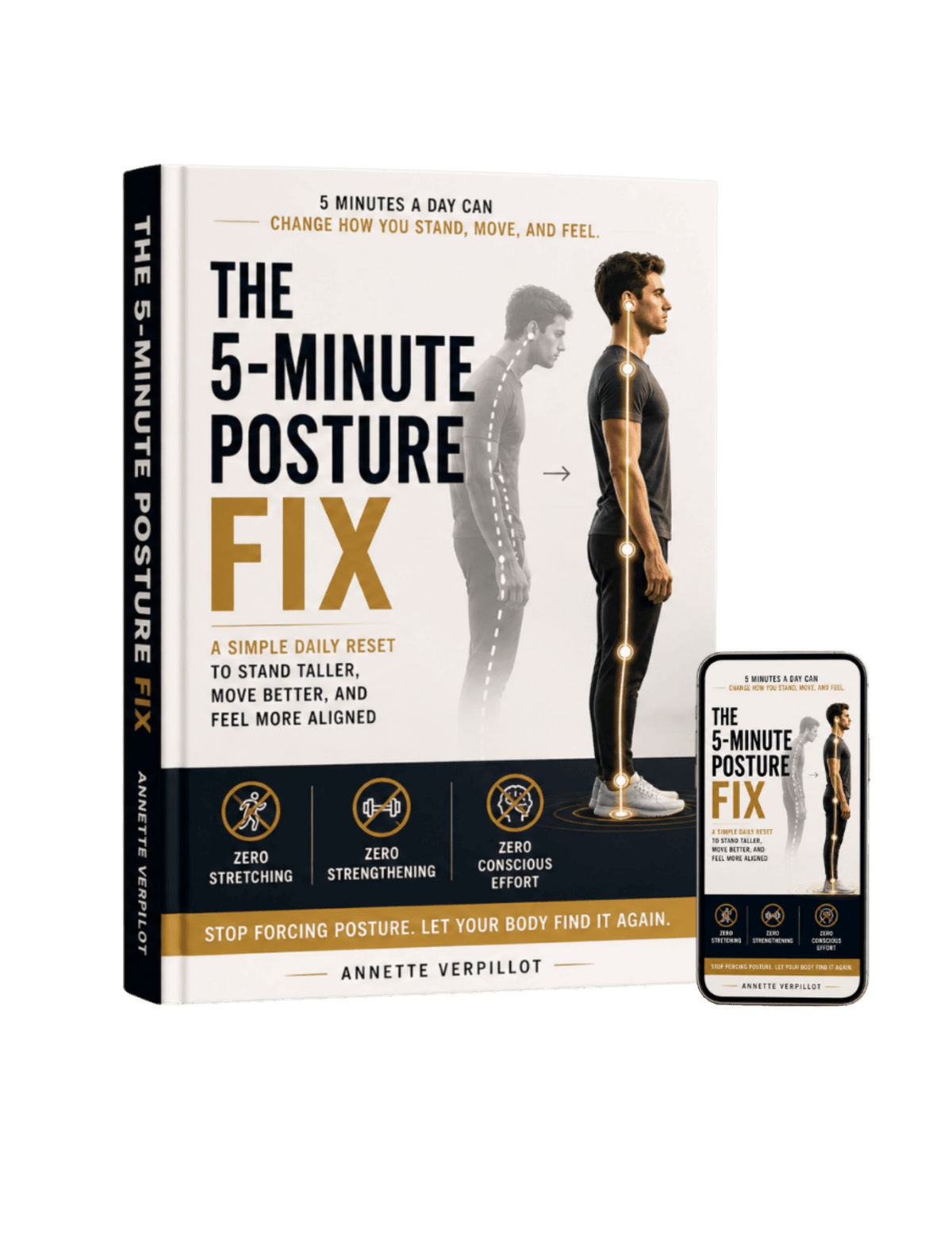
- ✓ Help reduce rounded shoulders and forward head posture caused by long hours sitting at a computer.
- ✓ Follow a simple, guided 5 minute routine designed for people who work from home or spend their days at a desk.
- ✓ Improve your posture without spending hours exercising, buying equipment, or constantly reminding yourself to sit up straight.
Common Questions About Rounded Shoulders
What exactly are rounded shoulders?
Rounded shoulders, also known as hunched, slumped, rolled or protracted shoulders, describe a posture in which the shoulders sit in front of the ears and the upper back curves forwards. Seen from the side, the upper back is visible behind the shoulder, and the palms tend to face backwards when the arms hang loosely. In a balanced posture, the ear sits directly above the shoulder.
What causes rounded shoulders?
In persistent cases, rounded shoulders follow a forward head posture. As the head drifts forwards, the brain rounds the shoulders to counterbalance it, and the head drifts because the feedback from the eyes, feet or jaw is distorted. Desk work reinforces the pattern but rarely causes it on its own.
Why won't my shoulders stop rounding, whatever I do?
Because rounded shoulders sit downstream of forward head posture. The brain moves the head forwards first and the shoulders round to balance it. The shoulders will follow the head until its position changes, and nothing changes for good until the feedback behind the head position does.
Can stretching the chest and working the back fix rounded shoulders for good?
Chest stretches and back exercises work on the muscles carrying out the movement, not on the neurological pattern pushing the head forwards. Unless the sensory feedback behind the compensation is addressed, the shoulders drift back into their rounded position.
Which exercises help with rounded shoulders?
Exercises work best in the correct order. Start by changing the feedback that keeps the head forward, then release and stretch the tissues holding the shoulders forwards, then strengthen the muscles controlling posterior tilt, upward rotation and gentle retraction of the shoulder blades, and finally practise the new position in daily movement. In the reverse order, the pattern usually returns within hours.
Did sitting at a desk give me rounded shoulders?
Desk work reinforces the pattern but seldom creates it. Two people can share the same desk for years and only one develops rounded shoulders, because the difference lies in the sensory feedback each brain receives, not in the desk.
How long does it take to correct rounded shoulders?
Once the underlying sensory pattern is addressed, the head can change position within the first session, with the shoulders following straight away, because the brain repositions the head as soon as it receives corrected feedback. Remodelling of the fascia and connective tissue usually takes six to eight weeks to settle.
Which three sensory systems control head position?
The brain sets head position using feedback from three systems that orient you to gravity: the eyes, the feet and the jaw. Each governs a different aspect of balance. If any one of them sends distorted feedback, the brainstem pushes the head forwards and the shoulders round to compensate. All three are identified and reset by the 5 Minute Posture Fix.
Should I build up my upper back to fix rounded shoulders?
Strengthening the upper back without first correcting head position can make the pattern worse. Those muscles are not weak; they are inhibited by the nervous system. The brain has turned their tone down so the rounding can counterbalance the forward head, and forcing them stronger without correcting the pattern only reinforces the compensation.
References
- Singla, D., & Veqar, Z. (2017). Association between forward head, rounded shoulders, and increased thoracic kyphosis: A review of the literature. Journal of Chiropractic Medicine, 16(3), 220-229. doi:10.1016/j.jcm.2017.03.004
- Yip, C. H., Chiu, T. T., & Poon, A. T. (2008). The relationship between head posture and severity and disability of patients with neck pain. Manual Therapy, 13(2), 148-154. doi:10.1016/j.math.2006.11.002
- Kavounoudias, A., Roll, R., & Roll, J. P. (2001). Foot sole and ankle muscle inputs contribute jointly to human erect posture regulation. The Journal of Physiology, 532(3), 869-878.
- Day, B. L., Steiger, M. J., Thompson, P. D., & Marsden, C. D. (1993). Effect of vision and stance width on human body motion when standing. The Journal of Physiology, 469(1), 479-499. doi:10.1113/jphysiol.1993.sp019824
- Gonzalez, H. E., & Manns, A. (1996). Forward head posture: Its structural and functional influence on the stomatognathic system. CRANIO, 14(1), 71-80.