


In this guide
Stretching hasn't helped. Strengthening hasn't helped. Yet one shoulder still sits higher than the other. This guide covers what nobody tells you about uneven shoulders and shoulder imbalance, and the simple test that shows where the problem really begins.
How to tell if one shoulder is higher than the other
Stand facing a mirror with your arms relaxed, and look at your collarbones.
Does one side sit higher than the other, even a little?

That difference is not random. Your brain is actively holding that shoulder up. When the shoulders look slanted, with the left higher than the right or the other way round, what you are seeing is this holding pattern, which is why the shoulders only level out once the feedback behind it changes.
Three more signs of shoulder asymmetry:
- A bra strap that keeps slipping off on one side
- A shirt collar that sits unevenly around your neck
- One shoulder looking further forward than the other when you glance down
Most people assume the higher shoulder is tight and needs stretching. It is the other way round.
The raised shoulder is the compensation. The real problem is whatever is causing it to rise.

That is why stretching the "tight" side and strengthening the "weak" side brings short-lived relief at best. You are working on the output, while the feedback driving it stays exactly the same.
Discover your posture pattern (quiz)
Why every exercise has let you down so far
You have done the exercises: shoulder shrugs, shoulder blade squeezes, upper trapezius stretches. Perhaps a physiotherapist even gave you a detailed corrective programme.
The shoulder levels out for a few days, then drifts back to the same uneven position. That is the trouble with uneven shoulder exercises in general: they reach the muscle but not the reason the brain put the shoulder there.
This is not a strength problem, and it is not a flexibility problem either.
It is a pattern problem.
The brain controls shoulder height. It positions your shoulders using the feedback it receives about where your body is in space. When that feedback is uneven, the brain compensates by shifting shoulder height to keep what it perceives as balance.
What is really going on
Your brain raises one shoulder because it is receiving distorted feedback from lower down. The shoulder is doing exactly what it should: compensating for an imbalance your brain has picked up elsewhere in the chain.
That is why two people can carry a bag on the same shoulder for the same number of years and only one ends up with uneven shoulders. The bag is not what makes the difference; the feedback each brain is processing is what counts.
Stretch or strengthen the shoulder without changing the feedback that created the asymmetry, and the brain puts it back in its old position the moment you stop concentrating. Not because the muscles are weak, but because the pattern has not changed.
Try the single-leg, eyes-closed test
- Stand beside a wall or something sturdy so you can steady yourself if you need to.
- Raise one foot off the ground and shut your eyes.
- Pay attention to how much you sway and how hard you have to work to stay upright.
- Swap legs, repeat, and compare the two sides.
Most people find that one leg is far less stable than the other. That instability is a sign of the uneven feedback that is driving the shoulder up.
This test takes care of the diagnosis. Correcting the pattern calls for a completely different sequence.
Why the test on its own is not the answer
The single-leg, eyes-closed test shows which system is behind the asymmetry. That is useful, but knowing which system is at fault is not the same as fixing it.
Uneven shoulders come from distorted feedback reaching the brainstem from three sensory systems that decide how the brain positions the shoulder girdle in relation to gravity. If even one of them sends uneven feedback, the brainstem raises one shoulder, rotates the spine and shifts the pelvis to match.
These systems can be tested, and they can be corrected. Tackled in the right order, shoulder height evens out in the same session, without stretching, strengthening or reminders to "pull your shoulders back".
The right correction sequence depends on which pattern you have.
- LEFT foot sending distorted feedback → right shoulder sits high
- RIGHT eye underperforming → left shoulder rises
- Uneven jaw alignment → one shoulder pulls forward and up
Using the wrong correction for your pattern? You end up reinforcing the compensation instead of dealing with the source.
The 5-Minute Posture Fix was designed for exactly this. It takes you through the diagnostic test that pinpoints YOUR pattern, then gives you the correction sequence that breaks the neurological loop behind the shoulder asymmetry. Five minutes, no equipment. The brain recalculates where the shoulder belongs because the feedback has changed.
If one shoulder keeps creeping higher whatever you do, the feedback has not changed yet.

Shoulder position before and after neurological pattern correction, with no shoulder exercises involved.
Five common mistakes adults make with uneven shoulders
Uneven shoulders are often misread and mistreated. Most attempts to fix them work on the wrong layer.
- Seeing it as a shoulder problem. Uneven shoulders are usually a knock-on effect of a rotated pelvis or uneven weight through the feet. Working on the shoulders leaves the cause untouched.
- Building up the lower side. The lower shoulder is often no weaker; it is reacting to a tilt somewhere else. Strengthening on its own will not resolve the asymmetry.
- Overlooking the pelvis. When the pelvis is rotated, the spine compensates and the shoulders mirror that rotation. The shoulders should be the last place you look, not the first. A pelvic tilt often shows up higher up as slanted shoulders, so reading the two together tells you far more than the shoulder line alone.
- One-sided posture cues. Telling someone to "lift the lower shoulder" forces a position the brain has not signed up to, and the pattern returns within minutes.
- Giving up too soon. Genuine asymmetry corrections take weeks to settle, because the brain has to rewrite a long-standing pattern.
5 Minute Posture Fix
Improve Your Desk Posture in Just 5 Minutes a Day
Working at a Desk All Day? Stop Letting Your Posture Pay the Price.
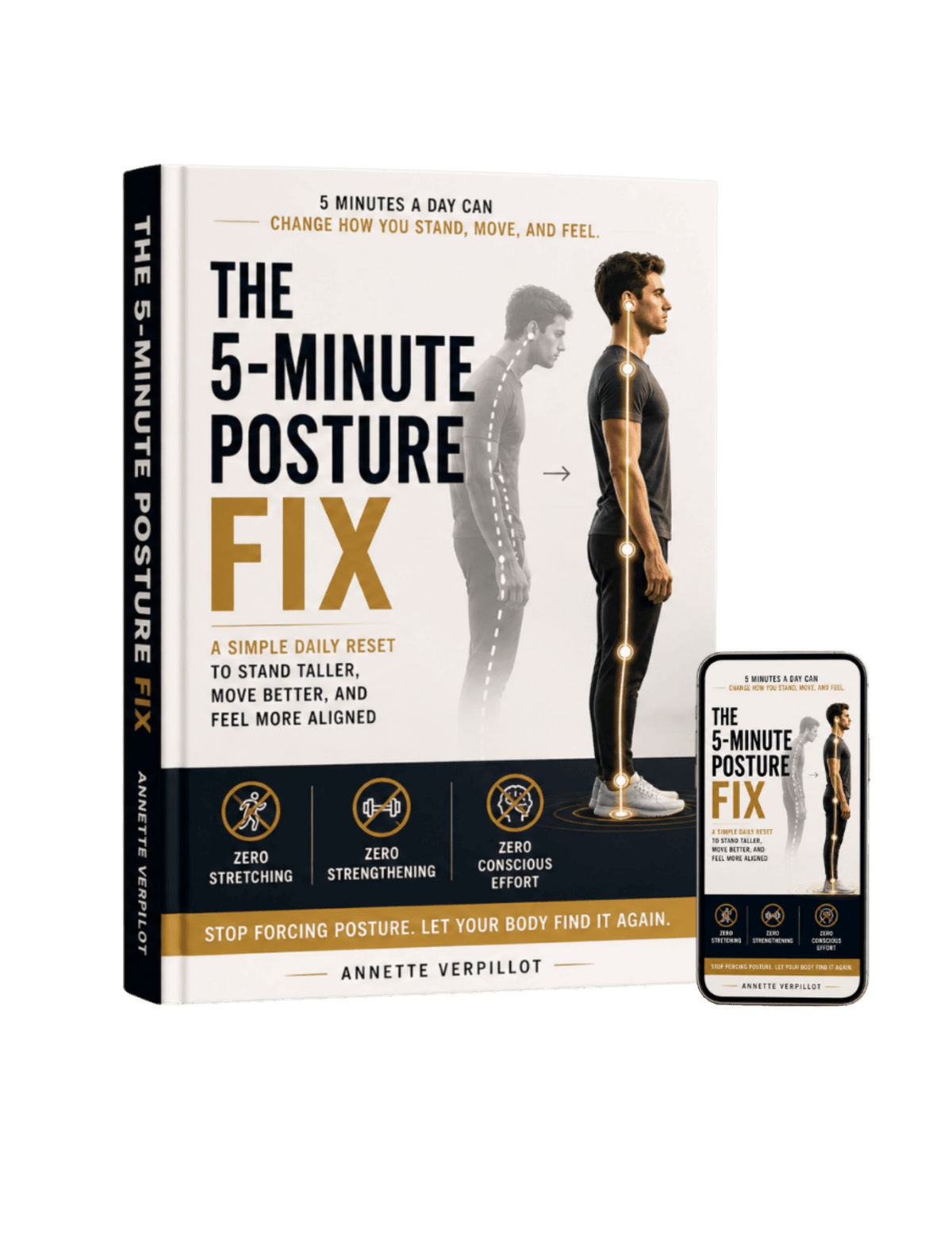
- ✓ Help reduce rounded shoulders and forward head posture caused by long hours sitting at a computer.
- ✓ Follow a simple, guided 5 minute routine designed for people who work from home or spend their days at a desk.
- ✓ Improve your posture without spending hours exercising, buying equipment, or constantly reminding yourself to sit up straight.
Your questions answered
Why does one shoulder stay higher whatever I do?
Because your brain is raising that shoulder in response to uneven feedback coming from below the neck. The height of the shoulder is the compensation; the source is whatever is sending the distorted feedback. Until that changes, the pattern stays.
Can uneven shoulders or a shoulder imbalance be corrected?
Yes. Once the feedback behind the pattern changes, the brain repositions the shoulder girdle by itself. Shoulder height can change within the first session, and the change takes 6 to 8 weeks to settle into the fascia and connective tissue.
Will shoulder exercises fix uneven shoulders for good?
Shoulder exercises strengthen the muscles that carry out the movement, but they do not alter the neurological pattern behind the asymmetry. Unless the sensory feedback that created the compensation is addressed, the shoulder goes back to its raised position.
Did carrying a bag on one shoulder cause this?
A bag on one shoulder strengthens the pattern but seldom causes it. Two people can carry a bag on the same shoulder for years and only one develops shoulder asymmetry. The deciding factor is not the bag; it is the sensory feedback each brain is processing.
How long do uneven shoulders take to fix?
Once the underlying sensory pattern is dealt with, shoulder height can change within the first session, as the brain repositions the shoulder as soon as it receives corrected feedback. Structural remodelling of the fascia and connective tissue usually takes 6 to 8 weeks to settle.
Which three sensory systems control shoulder height?
The brain sets shoulder position using feedback from three systems that anchor you to gravity, each handling a different aspect of balance. If even one sends uneven feedback, the brainstem raises one shoulder to compensate. The 5-Minute Posture Fix pinpoints and resets all three.
Should I work on strengthening my lower shoulder?
Building up the lower shoulder can actually make the asymmetry worse. That shoulder is not weak; it is neurologically inhibited, with the brain turning down tone on that side to balance the raised shoulder opposite. Forcing it to get stronger without correcting the pattern only reinforces the compensation.
Why are my shoulder blades uneven?
Uneven shoulder blades are usually part of the same pattern. When the brain raises one shoulder and rotates the spine, the shoulder blade on that side sits higher or further forward. Like the shoulder, it levels out once the feedback behind the pattern changes.
How do you correct shoulder posture when one shoulder is up and the other down?
Shoulder posture is set by the brain, not by the shoulders. When one is up and the other down, the brain is holding that position in response to uneven feedback from lower in the chain. To correct it, the feedback has to change first. Once it does, the brain repositions the shoulder girdle by itself, with no need to hold a corrected posture through effort.
How do you level a shoulder that sits higher than the other, or slanted shoulders?
Slanted shoulders are the visible end of an imbalance the brain is compensating for, often alongside a pelvic tilt or uneven weight through the feet. Levelling a higher shoulder means resetting the feedback the brain is reading, not forcing the shoulder down. The 5-Minute Posture Fix takes you through the test that identifies your pattern, then the correction sequence that lets the brain realign the shoulders at the source.
Do uneven shoulder exercises help, and what about a neck hump?
Uneven shoulder exercises strengthen the muscles that move the shoulder, but they do not change the pattern the brain is running, so the asymmetry comes back. A neck hump often goes hand in hand with uneven shoulders because both come from how the brain positions the body against gravity. Dealing with that shared source is what lets shoulder posture hold, instead of repeating exercises that only reach the surface.
Why are my shoulders uneven, and what causes it?
Uneven shoulders happen because the brain is holding one shoulder up in response to uneven feedback from lower down, most often from the feet, pelvis or jaw. The height difference is the compensation, not the cause, which is why the shoulders only level out when the feedback behind the pattern changes.
References
- Kavounoudias, A., Roll, R., & Roll, J. P. (2001). Foot sole and ankle muscle inputs contribute jointly to human erect posture regulation. The Journal of Physiology, 532(3), 869-878. PMC2278585
- Day, B. L., Steiger, M. J., Thompson, P. D., & Marsden, C. D. (1993). Effect of vision and stance width on human body motion when standing. The Journal of Physiology, 469(1), 479-499. PMC1143881
- Shaikh, A. G., & Zee, D. S. (2017). Eye Movement Research in the Twenty-First Century, a Window to the Brain, Mind, and More. The Cerebellum, 17(3), 252-258. doi:10.1007/s12311-017-0910-5
- Wang, Z., & Newell, K. M. (2012). Asymmetry of foot position and weight distribution channels the inter-leg coordination dynamics of standing. Experimental Brain Research, 222(4), 333-344. doi:10.1007/s00221-012-3212-7
- Oyarzo, C. A., et al. (2014). Postural control and low back pain in elite athletes. Journal of Back and Musculoskeletal Rehabilitation, 27(2), 141-146. PMID 23963269