


In this guide
- Why your head drifts forward
- What forward head posture actually is
- Why it matters more than you think
- Check your posture
- The muscles involved
- What is really behind it
- Why most fixes don't last
- What to do instead
- The hidden link between tongue and neck
- Neck hump and tech neck
- In summary
- Your questions answered
Why your head keeps drifting forward
Ever caught your reflection and wondered why your head pokes forward like that?
You are far from the only one. And no, it is not because your neck muscles are weak.
It is because your brain is doing exactly what it was built to do: keeping you safe by prioritising balance over appearance.
By the end of this guide, you will understand why your head keeps drifting forward however much you stretch, and you will learn the daily reset that works on the overlooked sensory systems behind upright posture. Not more strength, not more mobility. Only five minutes, working from the ground up.
Let's unpick the myths around forward head posture and look at what is really going on.
What forward head posture actually is
Forward head posture (FHP) is when the head sits forward of the spine. It looks like a slight stoop and feels like tight upper traps, but that is only the tip of the iceberg.
Ideal alignment? Seen from the side, your ear canal should sit directly above your shoulder.
Here is the catch:
FHP is not just a bad habit. It is a compensation pattern, a sign that your body is reorganising itself around faulty feedback.
Why it matters more than you think
It is easy to shrug off. Yet this small shift is linked to a long list of frustrating symptoms:
- Constant neck tension and pain at the base of the skull
- Daily headaches that feel like migraines
- A clicking or tight jaw (TMJ dysfunction)
- Shallow, inefficient breathing
- Dizziness or problems with balance
- Numbness or pins and needles down the arm
- Upper trapezius pain that never fully lets go
This is not just a posture problem. It is a whole-body dysfunction disguised as "tight muscles".
Your feet shape your head posture
Your head keeps pulling forward because your feet are sending the wrong balance information to your brain. When foot mechanics are off, the body compensates by moving the head forward to keep its centre of gravity, which creates the neck tension, upper back pain and postural slump that will not go away.
Check your posture
Test 1: the wall test

Stand with your back to a wall: back flat, shoulder blades touching it, pelvis neutral.
Keep your chin level.
Is the back of your head touching the wall?
If not, your body is compensating: your brain has moved your head forward for stability.
Test 2: the side photo check

- Have a photo taken from the side
- Draw a vertical line through the middle of your shoulder
- Draw another through your ear canal
- Does the ear line sit in front of the shoulder line?
Test 3: the neck rotation test

- Sit or stand tall with a straight back and relaxed shoulders
- Turn your head slowly to the left as far as is comfortable
- Then do the same to the right
What to look out for:
- Do your shoulders or torso turn with your head?
- Do you feel tightness, pulling or restriction on one side?
- Does one side feel harder than the other?
If your upper body moves as you turn your head, your cervical spine is not moving segment by segment as it should. The small stabilisers and deep neck muscles are not doing their job, so your body falls back on larger, cruder systems to compensate.
The muscles involved
The muscles below are affected by the imbalance, causing tension or weakness in particular areas. It is worth getting to know where they are.
Overactive or tight muscles
- Anterior scalene
- Sternocleidomastoid
- Front neck muscles of the lower cervical spine
- Sub-occipital muscles
- Splenius capitis and splenius cervicis
- Semispinalis
- Longissimus
- Upper trapezius (front fibres)
Weak or lengthened muscles
- Deep neck flexors (longus capitis and longus colli)
- Lower cervical extensors (multifidus, levator scapulae and erector spinae)
The exercises later in this guide target these muscles to help restore balance and function.
What is really behind it?
You are not sitting "wrong". Your nervous system is adapting to get by in a body that is running on distorted data.
Forward head posture is not a sign of laziness. It is a compensation strategy: your brain is trying to keep your eyes level and your airway open in a system that has drifted out of alignment at its sensory roots.
Here is what is really driving it:
Uneven contact between your teeth upsets jaw alignment. That imbalance alters the tension across the neck muscles, particularly the deep stabilisers, and your head shifts to find a symmetry that is no longer there.
Your eyes are distorting visual information, so the brain believes the world is tilted. To level your visual horizon, the head drifts forward and rotates slightly, just enough to keep you functioning, but at a price.
Your feet are sending the wrong signals up the chain. If one foot collapses more than the other, or ground pressure is uneven, the pelvis twists or tilts. The result is an anterior pelvic tilt that tips your whole torso forward.
The neck itself is not the problem. It is simply where your body compensates.
Retrain the position rather than the muscle
Since your head position is governed by the feedback your brain receives rather than by effort, the solution has to work on that feedback every day. That is exactly what the 5 Minute Posture Fix is designed for: a brief, guided reset you do each day in five minutes.
Why most fixes don't last
Most posture programmes treat the body like a stack of building blocks, telling you to stretch what is tight and strengthen what is weak.
That misses the point.
Your posture is run by your brain, not your biceps.
Until you retrain the feedback your brain receives, your muscles will keep slipping back into forward head posture. It is not laziness; it is neurology.
What to do instead
Here is a preview of the approach that works:
Step 1: correct the feedback
Before anything else, the feedback needs fixing.
Your eyes and feet, your connection to the ground, are flooding your brain with confusing data. That is the starting point.
Step 2: reset brainstem reflexes
Primitive reflexes such as the asymmetrical tonic neck reflex (ATNR), hard-wired into the brainstem, can lock the head into faulty positions. Until these reflexes are integrated, your body will keep sliding back into asymmetry however much you stretch or strengthen.
Step 3: tongue posture
Your tongue influences the position of your jaw and skull, so correcting it has a knock-on effect on your posture.
Step 4: then strengthen the neck
Only once your brain trusts the new feedback will it allow lasting change in the muscles.
1. Neck releases
First, the tight muscles holding your head forward need releasing.
a) Sub-occipital and back of the neck

How to do it:
- Lie on your back on a firm surface
- Place a massage ball under the base of your skull, on the muscles either side of the spine rather than on the spine itself
- Apply gentle pressure. You should feel a deep but bearable release, not sharp pain
- Turn your head slowly from side to side to find the tight spots between the base of the skull and the top of the neck
- Spend 2 to 3 minutes on each side, breathing deeply and letting your neck relax fully into the ball
- No ball? Press slowly and steadily into the same areas with your fingers
b) Eye exercises

How to do it:
- Sit up tall, keeping your head still and your eyes level
- Hold your index finger or a pen upright in front of your nose, at arm's length
- Focus on the tip
- Slowly bring it towards the tip of your nose, as close as you can before it doubles
- Hold your focus for 2 to 3 seconds
- Slowly move it back to the start, keeping your eyes fixed on it
- Repeat 10 to 15 times
c) Diaphragmatic breathing

How to do it:
- Lie on your back with knees bent and feet flat, using a small pillow under your head while keeping your neck relaxed
- Rest one hand on your chest and the other on your stomach
- Aim for the lower hand to rise while the upper hand stays mostly still
- Close your mouth
- Press your tongue gently against the roof of your mouth, which engages stabilising cranial and airway reflexes
- Breathe in through your nose and feel your lower ribs widen outwards and sideways, not upwards
- Breathe out slowly through your nose or lips, feeling your ribs draw in and your spine settle gently towards the floor
- Keep your jaw relaxed
- If your jaw clenches or your neck tightens, stop: you are slipping back into compensation. Reset
- Duration: 3 minutes
The hidden link: how tongue position governs your neck
You now know that forward head posture is less about weak neck muscles and more about faulty feedback to the brain. One crucial piece remains: where your tongue sits.
Your tongue is linked directly to the deep neck flexors through a network of fascia and muscle. When it rests low in the mouth instead of against the palate, a chain reaction follows:
- The hyoid bone drops and pulls on the front neck muscles
- The deep neck flexors become inhibited and weak
- Your head shifts forward to keep the airway open
- The sub-occipital muscles overwork to keep your eyes level
That is why neck stretches alone never solve the problem: they leave the tongue-neck connection behind the dysfunction untouched.
Neck hump and tech neck: one forward-head pattern
A neck hump and tech neck are two names for the pattern described throughout this guide: the head drifts forward and the rest of the body adapts to it. The small mound at the base of the neck is tissue the body builds up to support a head that sits in front of the shoulders. Screens get the blame for the nickname, but tech neck obeys the same rule as every forward-head pattern: the brain balances a heavy head using whatever information it has.
That is why getting rid of a neck hump rarely comes from working on the hump itself, and why a passive neck hump corrector tends to disappoint. Once the head returns to its natural place over the shoulders, the tissue that supported it is no longer needed and gradually fades. Correct the position and the hump follows.
In summary
If your head keeps drifting forward, your neck always feels tight and your posture springs back the moment you stop thinking about it, your muscles are not to blame.
Your map is.
Your brain is organising your posture around distorted feedback: an uneven bite, faulty foot contact, unstable vision. It is not a bad habit. It is survival.
And unless the feedback your brain receives changes, no amount of chin tucks, stretches or neck exercises will hold.
The exercises and techniques in this guide go after the real problem: the sensory systems in charge of your posture. Start with the tests, work through the releases, and give your brain the accurate feedback it needs to hold your head in the right place naturally.
Remember: lasting posture change works from the inside out, not by forcing your shoulders back or tucking your chin. Correct the feedback, and your posture corrects itself.
5 Minute Posture Fix
Improve Your Desk Posture in Just 5 Minutes a Day
Working at a Desk All Day? Stop Letting Your Posture Pay the Price.
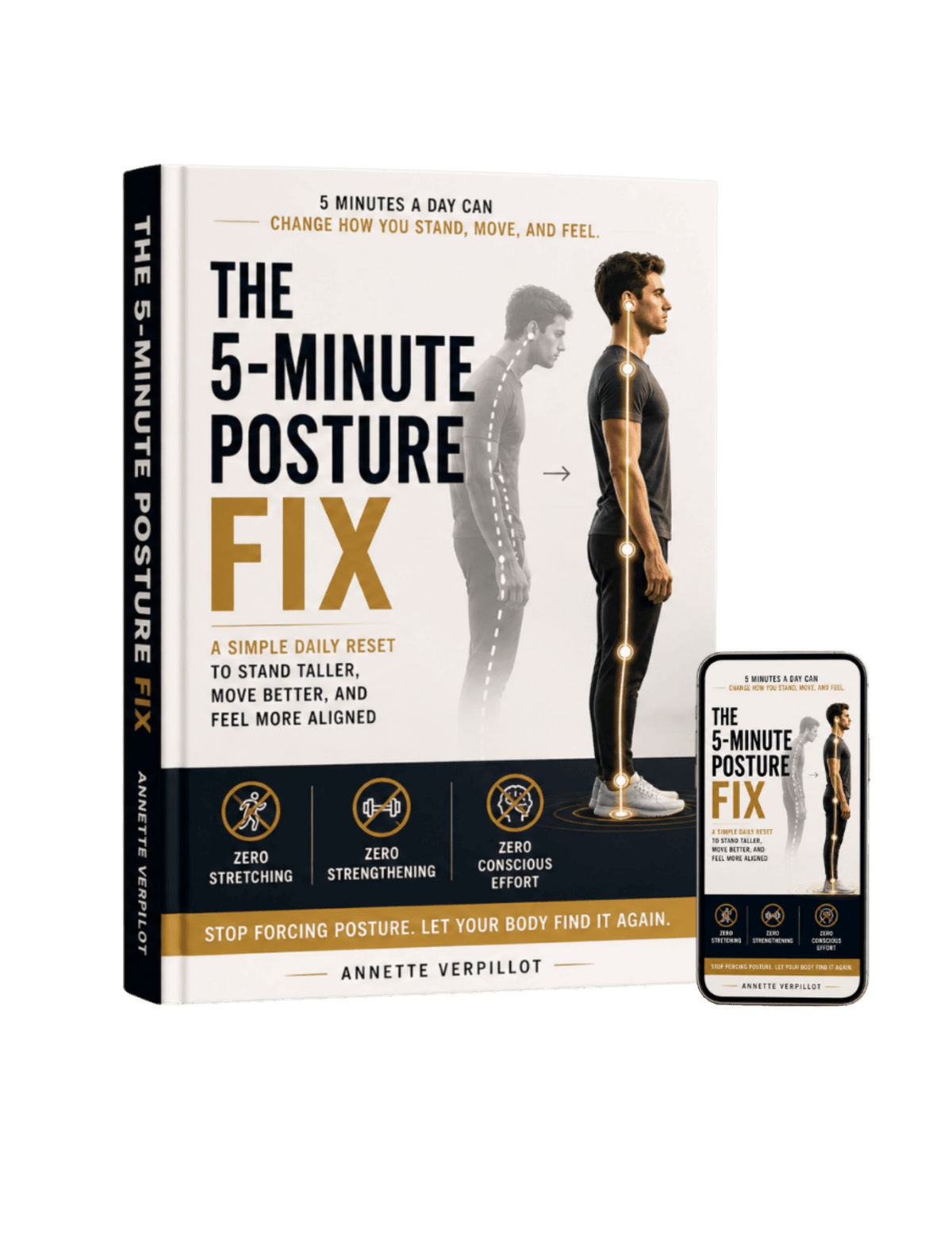
- ✓ Help reduce rounded shoulders and forward head posture caused by long hours sitting at a computer.
- ✓ Follow a simple, guided 5 minute routine designed for people who work from home or spend their days at a desk.
- ✓ Improve your posture without spending hours exercising, buying equipment, or constantly reminding yourself to sit up straight.
Your questions answered
How long does forward head posture take to correct?
With regular practice of the exercises and techniques in this guide, most people notice better posture awareness within the first week. Visible changes in neck alignment and muscle balance usually follow after 3 to 4 weeks of daily practice. Bear in mind you are retraining neurological patterns built up over years, so patience and consistency matter.
Can forward head posture make you dizzy?
Yes, forward head posture can contribute to dizziness and balance problems. When the head shifts forward, it affects the alignment of the inner ear, which governs balance, and can compress blood vessels supplying the brain. Tension in the sub-occipital muscles can also irritate nerves that communicate with the brain's balance centres.
Can forward head posture be reversed?
In most cases, yes. The key is tackling the root cause, the feedback your brain receives, rather than just stretching tight muscles. Retraining your visual system, improving foot mechanics and restoring healthy breathing patterns can bring lasting change in where your head sits.
Can you correct rounded shoulders and forward head posture at the same time?
Yes, and it makes sense to, because the two are usually part of the same compensation pattern. Correct the feedback first, then release the tight muscles and strengthen the neck, in that order. Stretching the chest or tucking the chin on its own will not hold while the brain is still organising your posture around distorted feedback.
How is forward head posture different from text neck?
Text neck is a particular form of forward head posture caused by looking down at devices. The symptoms are similar, but text neck tends to be more acute and tied to a specific activity. Forward head posture is a long-standing postural pattern that persists whatever you are doing and involves deeper neurological compensation.
Why does my forward head posture worsen when I'm stressed?
Stress activates the sympathetic nervous system (the fight-or-flight response), which tightens the muscles of the neck and shoulders. That protective tension draws the head forward. Stress also tends to bring shallow chest breathing, which reinforces the forward head position further as the body tries to open the airway.
How can you get rid of a neck hump?
A neck hump shrinks once the head stops sitting in front of the shoulders. The tissue at the base of the neck builds up to support the forward load, so the lasting approach is to restore the head's natural position. When that load goes, the body stops reinforcing the hump and it gradually flattens.
How do you sort out tech neck?
Tech neck is simply forward head posture with a modern nickname, and it responds to the same approach: change what drives the head forward instead of forcing the shoulders back. Raising screens to eye level helps, but lasting change comes from retraining the reflexes that hold the head upright, which is why the daily reset described above works from the ground up.
Which exercises help with forward head posture?
Stretching and strengthening on their own rarely last, because head position is set by reflexes, not willpower. The practices that stick are the ones that retrain those reflexes daily, like the five-minute reset in this guide. Think of it less as exercise and more as teaching your brain again where your head belongs.
References
- Szczygieł, E., Węglarz, K., Piotrowski, K., et al. (2019). Biomechanical influences on head posture and the respiratory movements of the chest. Acta of Bioengineering and Biomechanics, 21(2), 35-41.
- Kang, J. H., Park, R. Y., Lee, S. J., et al. (2012). The effect of the forward head posture on postural balance in long time computer based worker. Annals of Rehabilitation Medicine, 36(1), 98-104.
- Cho, J., Lee, E., & Lee, S. (2017). Upper thoracic spine mobilization and mobility exercise versus upper cervical spine mobilization and stabilization exercise in individuals with forward head posture. BMC Musculoskeletal Disorders, 18(1), 525.
- Sheikhhoseini, R., Shahrbanian, S., Sayyadi, P., & O'Sullivan, K. (2018). Effectiveness of therapeutic exercise on forward head posture: A systematic review and meta-analysis. Journal of Manipulative and Physiological Therapeutics, 41(6), 530-539.
- Lee, M. Y., Lee, H. Y., & Yong, M. S. (2014). Characteristics of cervical position sense in subjects with forward head posture. Journal of Physical Therapy Science, 26(11), 1741-1743.