


In this article
You can do all eight of these eye training exercises at home with no special kit. If screen time leaves your eyes tired, or you are after eye exercises to improve your vision and keep it in good shape, this routine helps your eyes work together, eases fatigue and lifts how well you see from day to day.
The exercises train the muscles that steer the eyes and sharpen the link between eyes and brain. Practised regularly, they can bring better focus, less strain and smoother visual tracking.
In a nutshell
Eight exercises, no equipment: palming, changing focus, figure of eight, near and far focus, eye rolls, deliberate blinking, pencil push-ups and zooming. A few minutes each day eases screen strain and helps your eyes focus, track and cooperate. Your glasses prescription will stay the same, but your eyes will use the vision you have more efficiently.
What the Science Says About Eye Training
Eye movements are closely tied to the brain's neural pathways. They can affect the dopaminergic system, which governs dopamine levels in the brain. Dopamine is a neurotransmitter involved in reward, motivation and alertness, and this link goes some way to explaining why well-designed eye training can help both vision and thinking.
If you have a specific problem such as convergence insufficiency, the NeuroVision course provides focused eye movement training.
Read more: eight eye exercises that sharpen focus and posture (free e-book included with the Posturepro+ subscription).
Eight Eye Training Exercises for Focus and Eye Strain
1. Palming

Palming is one of the simplest ways to rest the eyes and calm the mind. It soothes tired eyes and encourages the whole body to unwind.
Step by step:
- Sit in a comfortable position and rub your hands together until they feel warm
- Close your eyes and cup your palms over them lightly, without pressing
- Picture total darkness and breathe deeply
- Stay like this for two to three minutes
2. Changing Focus

This simple but effective exercise trains your ability to focus and helps the two eyes work as a team.
Step by step:
- Hold your thumb roughly 25 cm from your face and focus on it
- Move the thumb slowly away, keeping it in focus
- Switch your focus to something about 4.5 metres away
- Keep alternating between your thumb and the far object for one to two minutes
3. Figure of Eight

Tracing a figure of eight makes the eyes more flexible and better controlled, which improves tracking and coordination.
Step by step:
- Picture a large figure of eight around 3 metres in front of you
- Follow its outline with your eyes, slowly and evenly
- After a minute, reverse the direction
- Keep going for two to three minutes in total
4. Near and Far Focus

A useful exercise for strengthening the eye muscles and helping you switch focus quickly and smoothly.
Step by step:
- Sit comfortably with your thumb about 25 cm from your face
- Look at your thumb for a few seconds
- Move your focus to an object 3 to 6 metres away
- Switch back and forth between the thumb and the distant object several times
- Carry on for two to three minutes
5. Eye Rolls

Eye rolls are an easy way to loosen the eye muscles and encourage blood flow.
Step by step:
- Sit comfortably and close your eyes
- Roll your eyes slowly in a circle, clockwise first
- Then roll them anticlockwise
- Do this for around a minute
6. Deliberate Blinking
Blinking eases dryness and strain and keeps the eyes moist and comfortable, particularly when you spend a long time on screens.
Step by step:
- Set a two-minute timer
- Blink on purpose once every four seconds
- Let each blink be slow and full
- It is a simple counter to digital eye strain
7. Pencil Push-Ups
Pencil push-ups train convergence and build the eye muscles you rely on for close work. They are the best-known convergence exercise, a type of drill that teaches both eyes to point at a nearby target together.
Step by step:
- Hold a pencil at arm's length and look at its tip
- Bring it slowly towards your nose, keeping the tip in focus
- As soon as it turns double, take the pencil back to where you started
- Repeat ten times
8. Zooming

Zooming trains focus and coordination across a range of distances.
Step by step:
- Hold your thumb out at arm's length and focus on it
- Draw it slowly towards your face, keeping it sharp
- Stop when it is about 7 cm from your nose
- Return it to arm's length
- Repeat for one to two minutes
Extra Tips for Better Results
Little and often works better than long, infrequent sessions. A few minutes each morning as an eye warm-up, with brief resets while you are on screens, keeps the eye muscles coordinated without tiring them. Fit the exercises to how your day is going: palming and blinking when your eyes feel tired, and eye focus exercises such as changing focus and pencil push-ups when you need sharper close work. Approach them as you would any other kind of training: gentle, regular and gradually progressed.
If you want to take eye training further, the NeuroVision course teaches eye movement techniques that retrain how the brain controls posture.
How Eye Movement and Brain Function Are Linked
Eye exercises do more than train the visual system; they also support how you think. The link between eye movement and brain activity shows up most clearly in vertical eye movements, which can affect dopamine pathways. It is a striking example of how good eye training can help both vision and wider neurological health.
The Brainpro App
Use your eyes to train your brain. That is the thinking behind Brainpro, Posturepro's app that turns this style of eye training into a guided routine for every day: four exercises, five minutes a day and no equipment needed.
Every session uses eye movements to work on particular areas of the brain, with the aim of better posture, balance and coordination. A target dot guides your eyes through each drill while your head stays still, so the exercises described above gain pacing, progression and a routine short enough to fit into the time you spend brushing your teeth.
You can see what each drill trains, and how a session runs, on the Brainpro eye training app website. The app is available for iPhone from the App Store.
When You Can Expect Results

Many people feel a difference almost straight away, because accurate visual feedback quickly resets how the brain organises posture, focus and movement. When the eyes deliver clear, reliable information, the nervous system reacts in real time, and you notice it in your posture, your mood and how grounded you feel. That is what happens when you work on the cause rather than the symptom.
In Summary
Regular eye training is an easy, effective way to support your vision naturally. Building these eight exercises into your day can ease eye strain, strengthen the eye muscles and improve your visual performance overall.
Bear in mind that vision problems can sometimes point to an underlying posture issue. Where the eyes go, the head follows, so eyes that are well trained tend to show up in how the whole body holds itself.
Begin with five to ten minutes a day and build up as the exercises become a habit. It is a small investment that your eyes will repay in comfort and performance.
NeuroVision
Discover How Your Eyes Influence Your Posture, Balance, and Coordination.
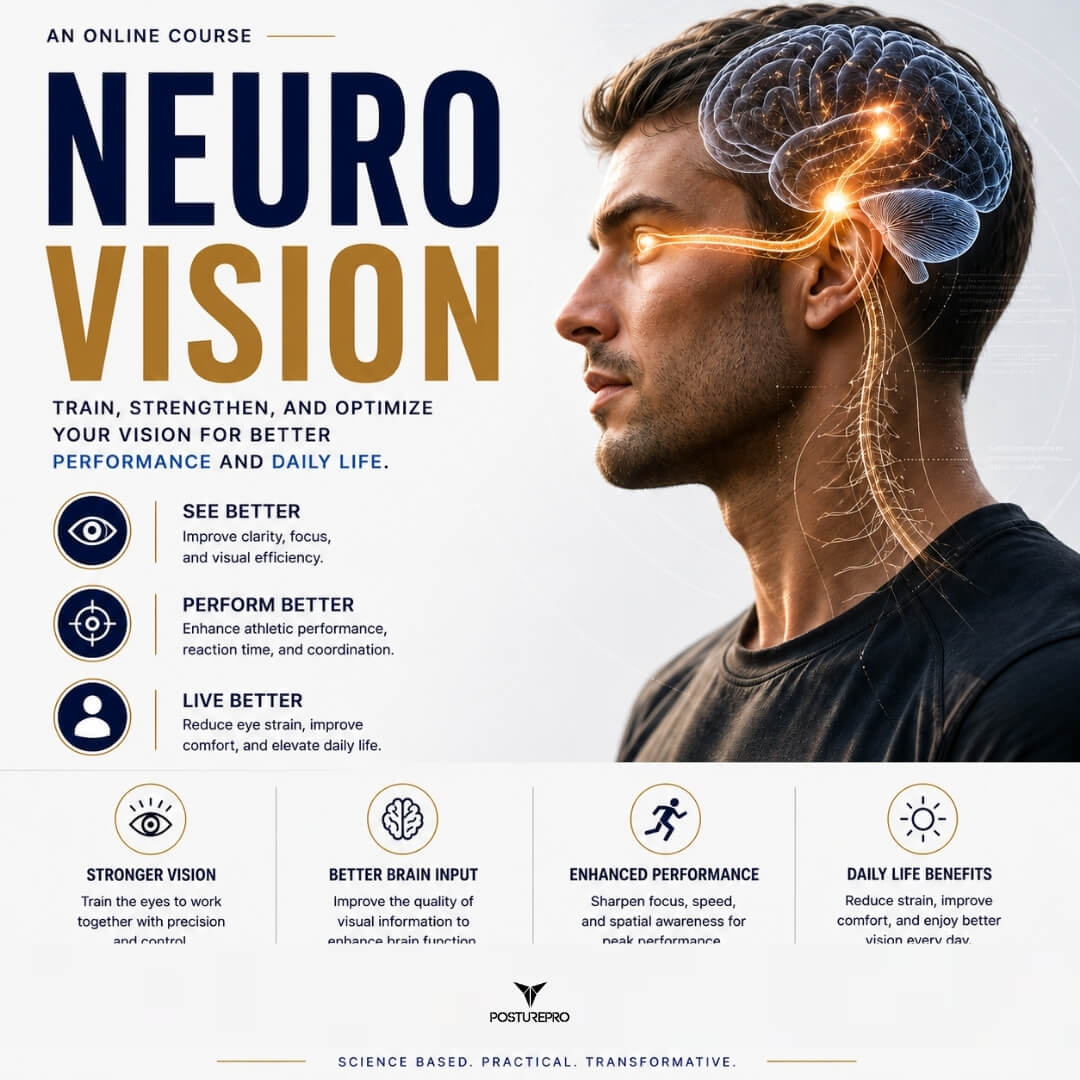
- ✓ Understand how eye movements, visual processing, and visual imbalances can influence posture and body alignment.
- ✓ Explore the neurological connections between your eyes, brain, balance, and movement.
- ✓ Learn practical visual assessments and techniques to identify visual imbalances and understand their influence on your body’s performance.
Common Questions About Eye Training
How often should I practise these eye exercises?
Aim for one to three minutes a day, ideally in the morning. Shorter sessions spread across the day work too.
Will vertical eye exercises improve my eyesight?
Eye exercises do not alter the parts of the eye that cause refractive errors, but they can make the eye muscles stronger and better coordinated, giving you more control over eye movement and less strain.
Do eye exercises help with eye strain from screens?
Yes. Practised regularly, eye exercises can ease the strain that builds up during long hours at a computer, by improving eye muscle coordination and reducing fatigue.
Are these exercises suitable for children?
Yes. These exercises are safe for children and can be especially helpful while eye coordination is still developing.
What does eye training involve?
Eye training means working the muscles and coordination patterns behind eye movement: focusing, tracking, converging and switching between near and far. The aim is smoother, more efficient movement with less strain, rather than any change to the shape of the eye.
What is an eye warm-up?
A brief routine of gentle eye exercises before screen work or concentrated tasks. Two or three of the exercises in this guide, for example palming, changing focus and a figure of eight, take only a few minutes and get the eyes switching focus and tracking smoothly without tiring them.
Can eye exercises genuinely improve vision?
They improve how the visual system performs: speed of focus, tracking, teamwork between the two eyes and comfort during long periods of close work. They do not correct refractive errors such as short-sightedness, so treat any promise to get rid of glasses with caution. What they do dependably improve is how well your eyes work as a pair.
How soon does eye training start to work?
Strain often eases within the first few sessions, as relaxing and coordinating the eye muscles has an instant effect. More lasting gains in focus and tracking tend to develop over several weeks of brief daily practice.
How does eye training affect posture?
Where the eyes point, the head follows, and the head's position shapes the posture of everything beneath it. When the eyes track and focus more efficiently, the head can settle in balance over the shoulders, which is why vision and posture so often improve together.
Which exercises train the eyes and brain together?
Exercises that guide the eyes along a deliberate path, such as the figure of eight, changing focus and vertical eye movements, work the eyes and brain at the same time. Eye movements are controlled by brain circuits connected to the dopamine system, which influences alertness and motivation, so this training reaches beyond the eye muscles.
Do eye exercises to improve vision really work?
Their benefits are functional: quicker focus, better tracking and closer cooperation between the two eyes. They cannot reshape the eye or reverse a refractive error, yet these functional improvements are what most people experience as clearer, more comfortable sight throughout the day.
Which eye exercises are best for eye strain?
Palming and deliberate blinking are the most effective for eye strain, as they relax the eye muscles and bring back moisture. Add focus changes and the 20-20-20 rule while working on screens to stop the strain from returning.
Is eye training the same as vision therapy?
Largely, yes. Eye training, vision training and vision therapy all refer to working the muscles and coordination patterns that control eye movement. The exercises here are the home-based version; clinical programmes use the same principles under professional supervision.
Can eye training make my eyesight better?
Eye training can improve how your eyesight performs, with quicker focus changes, steadier tracking and less strain. It does not fix refractive errors such as short-sightedness, so your glasses prescription stays as it is. What changes is how efficiently your eyes use the vision you already have.
References
- Hikosaka, O., & Wurtz, R. H. (1985). Modification of saccadic eye movements by GABA-related substances. Journal of Neurophysiology, 53(1), 266-291. doi:10.1152/jn.1985.53.1.266
- Schultz, W. (1998). Predictive reward signal of dopamine neurons. Journal of Neurophysiology, 80(1), 1-27. doi:10.1152/jn.1998.80.1.1
- Leigh, R. J., & Kennard, C. (2004). Using saccades as a research tool in the clinical neurosciences. Brain, 127(3), 460-477. doi:10.1093/brain/awh035